Short answer: A KMS activator fakes the Key Management Service that companies use for volume licensing, so Windows or Office look activated without a license. It isn't one. Defender flags such tools as hacktools. Microsoft has seen malware spread with them. We'd use a genuine retail key, which activates with Microsoft and needs no KMS host.
A KMS activator is an unofficial tool that fakes Microsoft’s Key Management Service so Windows or Office report as activated without a license. Real KMS belongs to organizations with a volume agreement. The fake version runs on a home PC, or points it at a stranger’s server. We’d treat both as unlicensed and risky.
| Real KMS in a company | A KMS activator at home | |
|---|---|---|
| Host key | A CSVLK from the Volume Licensing Service Center | None, nothing was bought |
| Where the host lives | On the organization’s local network | On the same PC, or on an unknown server online |
| Activation threshold | 25 client PCs, or 5 for servers and volume Office | Faked |
| License | Yes, under the volume agreement | No |
| Microsoft Defender | Nothing to detect | Tools of this kind are detected as hacktools |
Same three letters, opposite situations.
What a KMS activator is
Think of it as a costume. The tool dresses up as a company activation server, and Windows can’t see the difference from inside the PC. Many names float around for it. KMSpico is the best known. Same page for all of them, this one.
The names change. The idea doesn’t. Every KMS activator we’ve seen described pretends to be a host that only a licensed organization is supposed to run.
No download names, links or steps on this page, by the way. We explain what these tools are, and we sell keys that make them pointless.
Real KMS vs a KMS activator
Real KMS is plain office plumbing. Microsoft’s planning guide says KMS “uses a client-server model” and the host “must reside on your local network”. The host gets switched on with a Customer Specific Volume License Key. We’d add that it comes from the Volume Licensing Service Center, under agreements like Open, Select or Enterprise.
Then a counter kicks in. Client PCs activate once the host counts 25 of them, servers and volume Office once it counts five. Activation lasts 180 days, and clients try to renew every seven days. We go deeper in our guide to how KMS activation works.
A KMS activator keeps the plumbing and removes the paperwork. No agreement, no host key, no real count.
How a KMS activator fakes activation, in general terms
Only the outline here, no method. Three moves, in roughly this order:
- Volume key in. The edition gets one of the public client keys Microsoft lists on its KMS client key page. Those keys install an edition. Alone, they never activate it.
- Fake host answers. Something replies to the activation request the way a real host would, count included.
- Renewal on repeat. Since KMS activation runs out after 180 days, the tool schedules itself to renew again and again.
We found that last part in Defender’s encyclopedia entry for one of these hacktools. It “creates a task so that the tool is run everyday at the same time.” We’d find that line hard to forget.
Windows Home is the odd one out. It’s missing from Microsoft’s KMS tables, which list Pro, Enterprise and Education. So an activator can’t make Home a KMS client without changing the edition first.
A fake host on your PC or a stranger’s server
There are two flavours, and neither is better.
The first runs a fake host on your own PC. You install something with administrator rights that keeps running in the background. Whatever came bundled with it runs with the same rights.
The second skips the local part and points Windows at a public “KMS server” somewhere online. Your PC now checks in with a stranger’s machine. We’d see that as handing a stranger a regular line into your system, every week, for as long as the activation lasts.
Real KMS is supposed to sit on your own network for a reason. An outside host turns a licensing check into a trust problem.
Security risks we’d take seriously
Microsoft’s line on that Defender entry is short: “Don’t use hacktools as they can be associated with malware or unwanted software.” It adds: “We have seen malware distributed with these tools.”
- Unknown builds. No vendor signs these tools. Each download site serves its own copy, and we can’t verify any of them.
- Defender in the way. A download page that asks you to turn Defender off is a warning in itself. Microsoft counts disabling security software as tampering.
- Hidden extras. Microsoft’s categories include droppers and downloaders, built to put more malware on a device after the first file runs.
- Your accounts. Illegitimate downloads, Microsoft warns, can carry malware built to “steal your identity”.
The Microsoft criteria for malware and unwanted software lay out every category. Reading it next to a KMS activator’s download page is quite the experience.
Is a KMS activator a virus?
Not always by design. That’s the honest answer, and it doesn’t help much.
Microsoft keeps separate boxes. Malware steals, locks or spies. A hacktool, in Microsoft’s words, “can be used to gain unauthorized access to your device”. Then “poor industry reputation”. Software that trusted vendors already detect. A KMS activator lands in the hacktool box, and we’d never call that box safe.
The bigger problem is that you can’t check which file you got. The tool on one site and the tool on another share a name, nothing more. We’d treat every copy as unknown, because it is.
Windows 7 activator KMS: the old PC version
A lot of searches for a KMS activator come from Windows 7 machines. Fair enough, these PCs are still around. Here’s what we’d want you to know first.
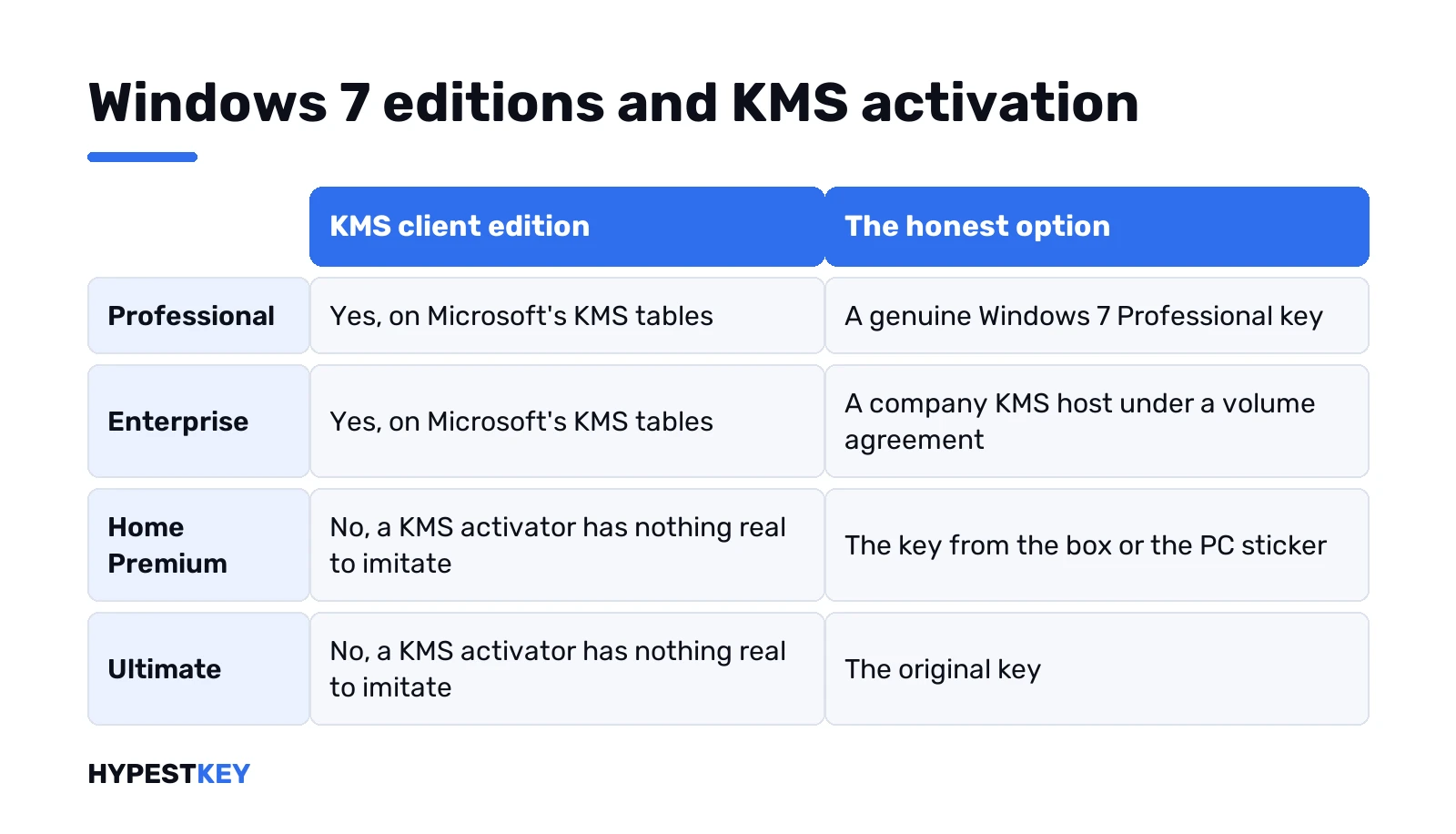
Only two Windows 7 editions were ever KMS clients. Professional and Enterprise appear on Microsoft’s KMS tables. Home Premium and Ultimate don’t, so on those a KMS activator has nothing legitimate to imitate in the first place.
Then the practical side. An old system plus a hacktool with admin rights is two weak spots on one machine. We’d fix one of them properly:
- Keep Windows 7. A genuine key for the edition, like our Windows 7 Professional key with online activation.
- Move on. We cover the route in our guide to upgrading Windows 7 to Windows 10. One catch. Windows 7, 8 and 8.1 keys stopped activating Windows 10 and 11 in 2023, so the newer system needs its own key.
If the original Windows 7 key is lost, check the sticker or the box first. Our page on finding your Windows product key lists the places.
What Defender says about a KMS activator
Microsoft keeps a public entry for one of the best-known KMS activators, HackTool:Win32/AutoKMS. It’s worth reading once. Plain language, no drama.
- What it is. A tool that “tries to activate an unregistered copy of Microsoft software”.
- What it leaves. A log file of activation attempts, plus that daily scheduled task.
- What Defender does. Detects it and removes it.
- What Microsoft suggests next. A full scan, because “a full scan might find hidden malware”.
One line in that entry says a lot: “Hacktools are often installed intentionally.” Nobody stumbles into a KMS activator. Someone chose it, usually to save the price of a key.
And the saving doesn’t hold. Defender removes the tool, renewals stop, and the activation runs out. Back to square one, minus some trust in the PC.
Office gets the same treatment, with its own twist about volume editions. That part lives on our page about the risks of an Office crack.
What US copyright law says
We sell keys, we don’t give legal advice. So here’s only the US statute, as written.
| Source | What it says |
|---|---|
| 17 U.S.C. §504(c)(1) | Statutory damages of not less than $750 or more than $30,000 per work |
| 17 U.S.C. §504(c)(2) | Up to $150,000 per work when the court finds the infringement was committed willfully |
The copyright owner can choose these instead of proving actual losses. The full text is at 17 U.S.C. § 504, Cornell Law School. Other countries have their own laws.
Checking whether your PC uses KMS
Settings first. On Windows 11: Start, Settings, System, Activation. On Windows 10 it sits under Update and Security.
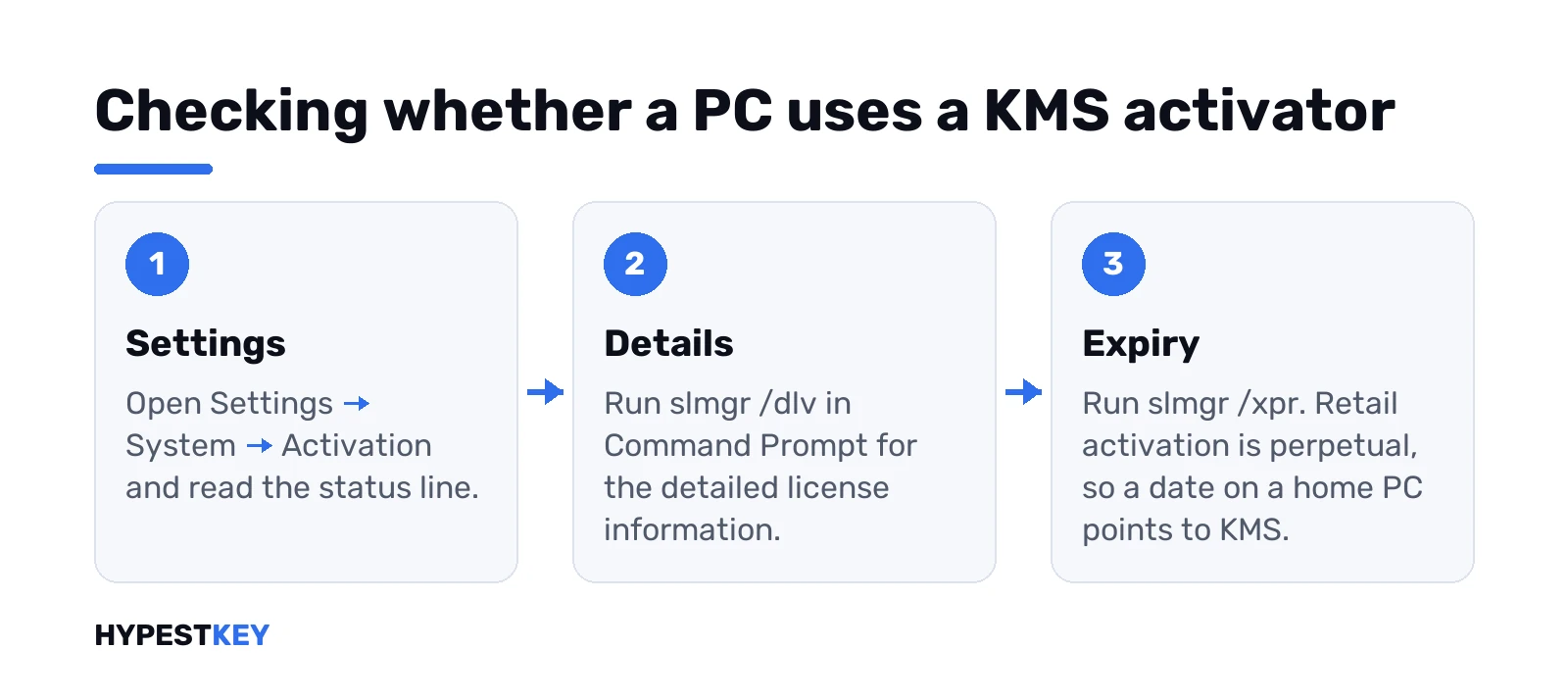
A home PC with a genuine license usually reads “Windows is activated with a digital license”, or with a key you entered. Then open Command Prompt for the detail:
slmgr /dlvThat shows detailed license information for the installed system. And the expiry:
slmgr /xprMicrosoft’s notes say the expiry check is “primarily useful for KMS clients, because MAK and retail activation is perpetual.” An expiry date on a home PC with no company network nearby? We’d read that as KMS-style activation, and at home there’s no real KMS host. We explain the rest in checking Windows activation status.
Getting off a KMS activator
Here’s the order we’d follow:
- Scan. A full scan in Windows Security.
- Passwords. Change the important ones from a device you trust.
- Reinstall. Clean Windows from Microsoft’s own media, since nobody knows what the tool changed.
- Real key. Settings, Activation, change product key.
Errors after removal are normal. Windows keeps looking for the host, which is where 0xC004F074 and friends come from. We’d start with our list of Windows 11 activation errors, then activating Windows 11 step by step.
Free generic keys won’t rescue you, our page on free Windows 10 and 11 keys explains why. For most PCs we’d go with the Windows 11 Pro key, retail, one PC, sent instant to email.
Lookalike sites and fake versions
Search the name and the results tell their own story. In the top results we looked at, most pages sat on unrelated or hijacked sites, from university blogs to community profiles. Each one claims the newest version. Each one has a different download button.
That matters because the file changes from site to site. Same name, same icon, and on another site maybe a password stealer. Microsoft’s write-up on a 2026 campaign describes counterfeit installers that set up persistence and “attempt to weaken security protections”. We wouldn’t bet a PC on telling them apart.
Version numbers don’t help either. Different sites promise different builds. None can be checked against an official source, because there isn’t one.
Stability, updates and the watermark coming back
Less dramatic, still annoying. A KMS-style activation needs to renew. Defender removes the tool, or an update changes something, and the renewal stops. Then the activation runs out and Windows reports “not activated” again.
Back comes the Activate Windows watermark. Sometimes an error code shows up too. Often it’s the KMS kind, like 0xC004F074, since Windows still looks for a host that’s gone.
Our list of Windows 11 activation errors and fixes explains the codes. With an activator in the picture, though, no fix sticks for long. We’d rather replace the key than keep patching it.
Checking Office activation
Any Office app. File, then Account. Product Information names the product you have.
Did you buy Home and Business, yet the name says Professional Plus? Something replaced it. Microsoft notes that a volume copy is named Office Standard or Office Professional Plus. Activation failed? The title bar then says “Unlicensed Product”, and most features are disabled.
Our page on Office product activation failed covers the genuine fixes. Same idea on a second-hand laptop with Office already on it: check the product name first, then worry about the rest.
Why people go looking for it
Price, nearly always. Windows costs money, and the activator promises to make that go away. We get it.
The honest options are fewer, but they’re real. Windows installs before you activate it, and our watermark page explains what changes while it stays unactivated. A generic key picks an edition. A retail key activates it, once, and you’re done thinking about it.
Some people also want Pro features on a Home PC. That’s an upgrade, not a hack, and we walk through it in upgrading Windows 10 Home to Pro.
Why a Windows 10 Pro activator txt stops working
Text pages with this name all follow one pattern. A few lines of batch code, a note to save them as a script, a note to run them as administrator. We won’t repeat any of it here. No code, no file, no steps.
The idea behind it comes from KMS, the Key Management Service. Companies use KMS for hundreds of PCs at once. An organization with a volume licensing agreement installs a KMS host key on its own server, and Microsoft activates that host. Office PCs on the same network then check in with the host.
Microsoft’s own KMS guide adds a detail that matters. A KMS host doesn’t activate anyone until it has seen at least 25 computers. A home PC has no host, no agreement and no 25 neighbours. So the txt script borrows somebody else’s server. On the internet, run by people we can’t name. We explain the legitimate side in our page on how KMS activation works in a company.
What the script changes on your PC
In general terms only. Three things happen:
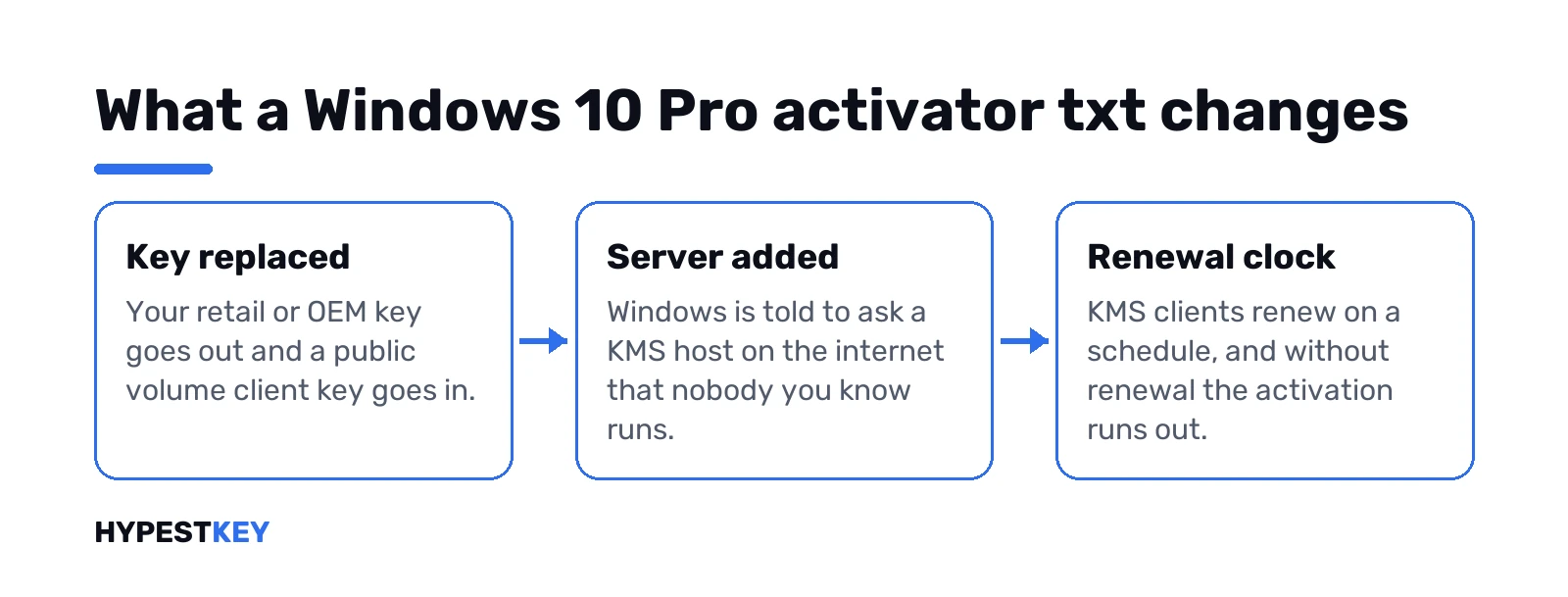
- Your key gets replaced. A retail or OEM key, if you had one, goes out. A public volume client key goes in, the kind Microsoft publishes for company PCs.
- Windows gets a new activation server. The script tells it to ask a host on the internet. Nobody you know runs that host.
- The clock starts. KMS clients renew on a schedule. Microsoft’s default renewal interval is seven days, and without renewal the activation runs out.
The public keys themselves are no secret. We list them on our page of official KMS client keys, and Microsoft publishes them openly. Those keys install an edition. They don’t activate it on their own, and that’s the whole reason the script needs an outside server.
Reinstalling after a script
Need a product key after a reinstall? Depends on what was there before the script.
- A digital license from an upgrade or a store purchase. Microsoft says a digital license doesn’t need a key typed in. After a clean install on the same hardware, Windows usually activates by itself once it’s online.
- A retail key you bought. Type it again during setup or later in Settings. Keep the email it came in.
- Nothing, only the script. Then there’s nothing to come back. A clean install ends up not activated, which is honest at least.
Lost track of the original key? Our guide on finding your Windows 10 product key covers the sticker, the email and the firmware. One catch. The script overwrote the installed key. Read it from Windows now and you’d get the public volume key, not yours.
What those text pages leave out
We read a lot of those pages for this article. Same promises everywhere: free, permanent, safe, one click. Here’s what we didn’t find on any of them.
- Who runs the server. Never named.
- What happens in a few months. Servers vanish, and the activation goes with them.
- Edition limits. KMS works for volume editions like Pro, Education and Enterprise, and a Home PC first gets switched to one of them.
- The license. Not a word about it, because there isn’t one.
Several of those pages also sell their own office suite or a paid tool in the next paragraph. Worth keeping in mind when a page calls the script free.
A used PC that came with a KMS activator
Bought a second-hand PC, and Settings says activated? Nice. Still worth a closer look, because a KMS activator leaves Windows looking normal until the renewals stop.
The two checks from above help here too. Look for three things:
- A KMS client channel. Odd on a home laptop.
- A KMS host name. Nobody in the house set one up.
- An expiry date. Retail never has one.
Any one of those and we’d assume a KMS activator was there before you.
Microsoft’s How to Tell shopping tips fit this case well. Two lines from them:
- Used before? “Find out whether the software has been installed and used before.”
- Paperwork. “Keep printed records of your order page, e-mails, receipts, and invoices for your software purchases.”
Ask the seller for the original key or the receipt. No paperwork, a KMS-style status, no company network? Then nothing was bought for that PC. We’d follow the cleanup order from the section on getting off a KMS activator, then put a genuine key on it.
Recovery discs are another thing people expect to fix it. Microsoft says they “are not licensed to be sold separately from the PC they were shipped with”. A disc from a market stall? Still no license.
The legal way: a genuine product key that activates on Microsoft’s servers. We sell Windows keys that activate online with Microsoft, with no scripts and nothing left running on the PC. We send each key instant to email.
Related guides
FAQ
Is a KMS activator legal?
No. Real KMS needs a volume licensing agreement and a host key, and the activator provides neither of them.
Is KMS activation itself legit?
Yes. Organizations with a volume agreement run their own KMS host, and their PCs activate against it on the local network.
Windows 7 activator KMS, does that even work?
Not for Home Premium or Ultimate. Only Professional and Enterprise were ever KMS clients on Microsoft's tables.
Why does my activation expire after a while?
KMS activation lasts 180 days and has to renew. When the fake host disappears, renewal fails and activation runs out.
Can Defender remove it?
Yes. Microsoft Defender detects tools of this kind as hacktools and removes them, so the fake activation stops renewing.
Will a free KMS client key activate my PC?
Not at home. Those public keys install an edition, and only a real KMS host on a company network activates it.
Is a KMS activator safe to run?
No. Microsoft Defender detects tools of this kind as hacktools, and Microsoft says it has seen malware distributed with them.
Is a tool like KMSpico legal?
No. It activates software nobody paid for, and in the US statutory damages can reach $150,000 per work if infringement is willful.