Short answer: HWID activation names a Windows digital license tied to your hardware. Unofficial activation scripts make one without any purchase. That's not a license. Genuine ones come from an eligible upgrade, a Microsoft Store purchase or a product key. We'd swap a scripted one for a real retail key.
HWID activation is the slang name for a Windows digital license tied to your PC’s hardware, and unofficial activation scripts promise one without a purchase. A real digital license comes from a genuine upgrade, a Microsoft Store purchase or a key. A scripted one has no sale behind it, so we’d call it unlicensed.
| Genuine digital license | Scripted HWID activation | |
|---|---|---|
| Where it comes from | A free upgrade from an eligible device, a Microsoft Store purchase, or a product key | A script run with administrator rights |
| Purchase behind it | Yes | No |
| Linked to a Microsoft account | Yes, if you link it | Nothing was bought, so nothing to link honestly |
| License | Yes | No |
The status line can look the same. The paperwork can’t.
What HWID activation means
HWID stands for hardware ID. Microsoft itself doesn’t use that phrase on its activation pages. It says digital license, or digital entitlement.
We’d quote Microsoft’s activation page here: a digital license doesn’t need a product key, it’s associated with your hardware and can be linked to your Microsoft account. Activation “pairs the product key or digital entitlement with the hardware configuration of the device”. We’d keep that sentence in mind for the rest of this page.
So in forums, “HWID activation” just names that pairing. The question is only where the entitlement came from. Our explainer on digital license vs product key covers the genuine side in full.
The genuine ways to get a digital license
Microsoft lists them on its Activate Windows page. For Windows 11:
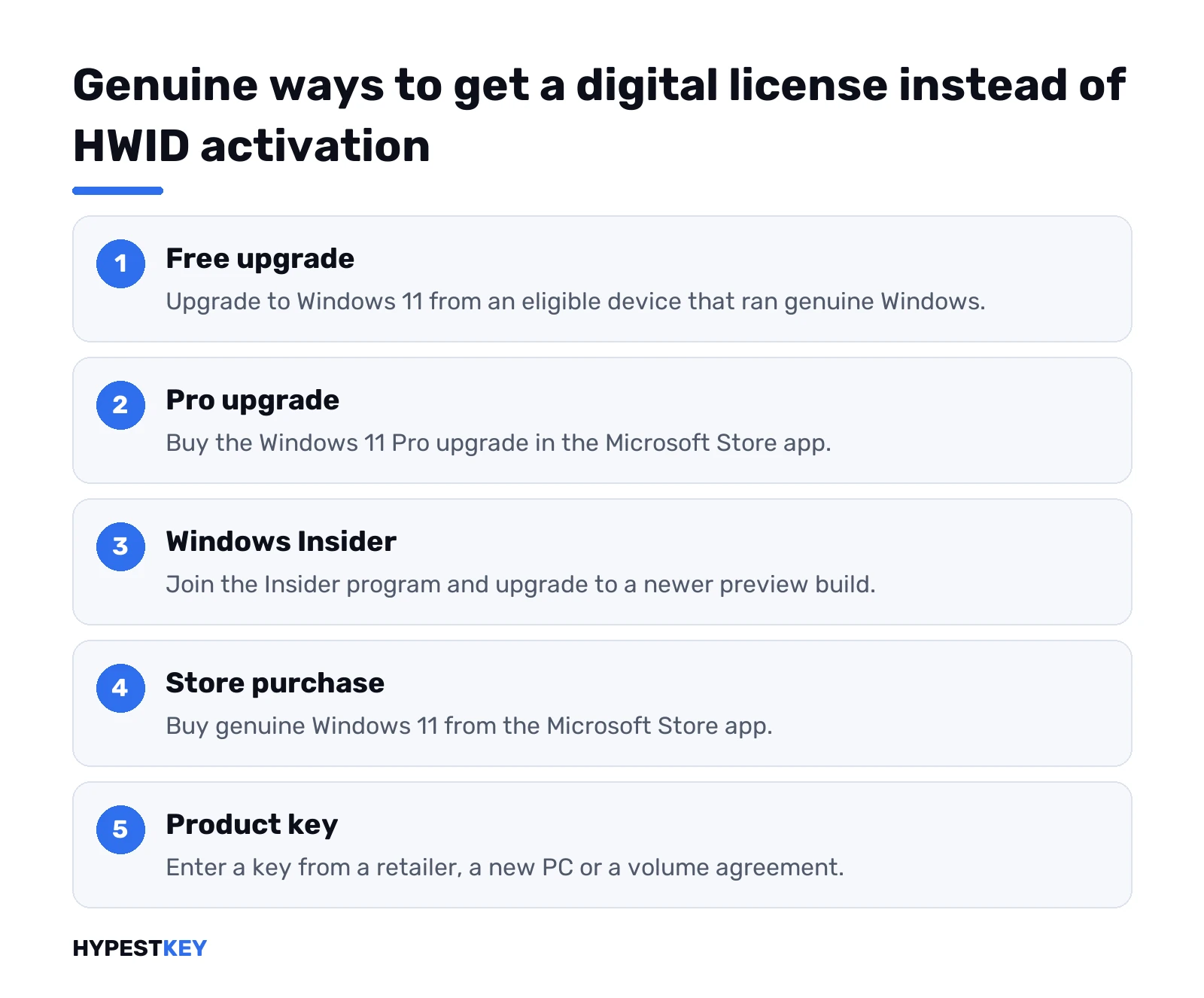
- A free upgrade. From an eligible device that already ran genuine Windows.
- A Pro upgrade. Bought in the Microsoft Store app.
- Windows Insider. Upgrading to a newer Insider Preview build.
- A Store purchase. Genuine Windows 11 bought from the Microsoft Store app.
One thing that’s no longer on that list. Windows 7, 8 and 8.1 keys stopped activating Windows 10 and 11 in 2023. That old sticker? No digital license from it now.
A product key is the other route. A PC that came with Windows, a box or digital copy from a retailer, a volume agreement. We sell that last kind of thing in retail form, more on that further down.
What these activation scripts are, and why they’re risky
Massgrave is the name behind MAS, short for Microsoft Activation Scripts. It’s an open-source collection of scripts, not a Microsoft product, despite the name. Several methods inside, for Windows and Office alike. HWID is the famous one.
We won’t name the other methods, link the project or describe how it’s run. That’s a firm rule on this site. What we will do is explain what it changes and what it doesn’t.
What HWID activation by script does, in general terms
Very roughly: the script gets Windows to record a digital license for this hardware. It’s the same kind of entitlement a genuine upgrade creates. Only nobody bought anything.
That’s why the result looks so clean. Settings may say “Windows is activated with a digital license”. No fake server stays on the PC, no daily task runs, unlike a KMS-based setup. People read that as proof it’s fine.
It isn’t proof. Microsoft says activation “does not guarantee that the copy of Windows is genuine”. A status line reports a state. It doesn’t create a license where no purchase happened.
Open source isn’t the same as licensed
This argument comes up a lot: the code is public, so it must be safe and legal. Two separate questions, really.
With public code, anyone can read what the script does. Fair point, and better than a closed file from a random site. It says nothing about whether you hold a license for Windows. A license comes from a purchase, never from a script, however tidy the code.
Legal and safe aren’t the same thing either. Code can be readable and still activate software you didn’t pay for.
The security risks of activation scripts
Most of the risk sits around the scripts rather than in them.
- Lookalikes. A popular name attracts copies. Microsoft’s security team describes counterfeit download sites that impersonate trusted software brands and hand out malicious installers.
- Admin rights. Changing licensing needs full administrator access. A wrong copy gets the same access.
- Trust. A script you didn’t write, run with full rights, is only as safe as whoever handed it to you.
- Mirrors. Copies on unknown code hosts can differ from the original, and few people compare them line by line.
Microsoft also warns that illegitimate downloads may carry malware made to “compromise your security, or steal your identity”. We’d keep the criteria Microsoft uses for malware and unwanted software in mind: password stealers, droppers, backdoors.
“Permanent” HWID activation and hardware changes
The big selling point online is the word permanent. Here’s what Microsoft actually says about digital licenses and hardware.
A significant change, like a new motherboard, can break the match. Windows then “will no longer find a license that matches your device”. The fix Microsoft offers is the Activation troubleshooter, and it works through a Microsoft account linked to a real license.
Microsoft’s page on reactivating Windows after a hardware change adds the fine print:
- Link first. On Windows 11 it calls linking your Microsoft account to the digital license “essential”. Before the new board goes in, ideally.
- Same edition. The license and key “will reactivate only if the edition remains the same.”
- Only when it’s broken. The troubleshooter shows up only while Windows isn’t activated. Pick “I changed hardware on this device recently” there.
We’d sum it up like this. A genuine digital license follows a documented recovery path. One made by a script has no purchase to fall back on when the hardware changes. We show the genuine path in our guide to moving a Windows license to a new PC.
Reinstalling is the other case. Microsoft says you can reinstall the same edition on the same device without a key, if Windows was activated before. Handy for a real license. Changes nothing about a scripted one.
What US copyright law says
We’re a key shop. No legal advice here, only the statute.
| Source | What it says |
|---|---|
| 17 U.S.C. §504(c)(1) | Statutory damages of not less than $750 or more than $30,000 per work |
| 17 U.S.C. §504(c)(2) | Up to $150,000 per work if the court finds the infringement was committed willfully |
The copyright owner can choose statutory damages instead of proving actual losses. Full text: 17 U.S.C. § 504 at Cornell Law School.
How to check your Windows activation
Settings first:
- Windows 11. Start, Settings, System, Activation.
- Windows 10. Start, Settings, Update and Security, Activation.
Look for “Windows is activated with a digital license linked to your Microsoft account”. That’s the status we’d want to see, because it has a recovery path. For more detail, Command Prompt and this:
slmgr /dliIt shows the license information for the installed edition. Then ask yourself one plain question: did anyone buy this? We cover the rest in checking Windows activation status.
Office on the same PC
These scripts don’t stop at Windows, so check Office too. Any Office app, File, Account. Product Information names the product.
You paid for Home and Business, and it says something else? We’d find out why. If activation fails, the title bar shows “Unlicensed Product” and most features are disabled. We cover genuine fixes on our page about Office activation failed, and activating Office 2021 shows a real key going in.
A used PC that already shows HWID activation
Second-hand laptop, Settings says “activated with a digital license”. Looks perfect. But that line reads the same after a genuine upgrade and after HWID activation by script, so the status alone can’t tell you which one you got.
Microsoft’s How to Tell shopping tips help more than any command here:
- History. “Find out whether the software has been installed and used before.”
- Records. Keep “your order page, e-mails, receipts, and invoices for your software purchases.”
- Where you shop. Microsoft suggests avoiding auction sites and P2P file sharing sites for downloads.
So ask the seller. A sticker, a receipt, a Store order? Fine. “It came like that” and no paperwork? Then we’d treat it as scripted HWID activation and put a genuine key on it, as shown in the next section.
Sign in with your own Microsoft account afterwards. Then the license follows you, not the previous owner.
Turning HWID activation into a real license
Good news: this part is easy. You don’t need to wipe the PC to fix the license itself.
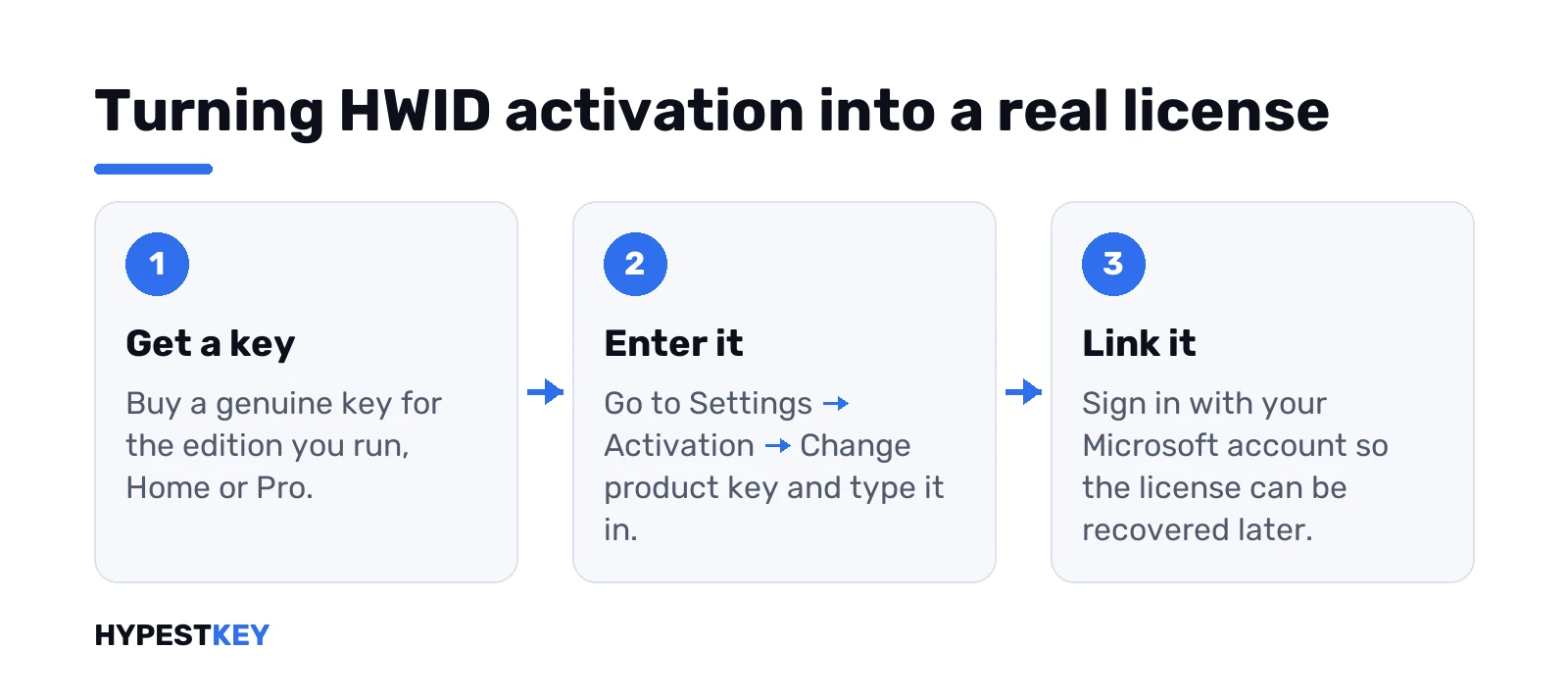
- Get a key. One for the edition you run, Home or Pro.
- Enter it. Settings, Activation, change product key.
- Link it. Sign in with your Microsoft account so the license can be recovered later.
Ran a copy from an unknown site? Then we’d scan and do a clean install from Microsoft’s media first. Errors along the way? We’d check our list of Windows 11 activation errors and the Windows 11 activation guide. Free generic keys won’t do it. Our page of free Windows 10 and 11 keys explains why.
Running Home and want Pro? That’s a key change, see upgrading Home to Pro. For most PCs we’d go with the Windows 11 Pro key, retail, one PC, sent instant to email.
The legal way: a genuine product key that activates on Microsoft’s servers. We sell Windows keys that activate online with Microsoft, with no scripts and nothing left running on the PC. We send each key instant to email.
Related guides
FAQ
Is HWID activation legal?
The digital license itself is. Getting one from a script without buying Windows isn't, since no license was ever sold.
Is an activation script safe if it's open source?
Public code helps you read it. It doesn't make the activation licensed, and lookalike copies are a real risk.
Is HWID activation really permanent?
A digital license is tied to hardware. After a big change like a new motherboard, Windows may no longer find a match.
Will a new key overwrite it?
Yes. Settings, Activation, change product key, and Windows activates with the key you actually bought.
Do I have to reinstall Windows?
Not for the license. If you ran a copy from an unknown site, we'd scan and reinstall from Microsoft media first.
Do these scripts touch Office as well?
They can. Check Office under File, then Account, and make sure the product name matches what you paid for.
My old Windows 7 key, will it give me a digital license?
No. Windows 7, 8 and 8.1 keys stopped activating Windows 10 and 11 in 2023, so a newer system needs its own key.
New motherboard, now what?
Depends on the license. A genuine one linked to your Microsoft account goes through the Activation troubleshooter, "I changed hardware on this device recently". A scripted one has nothing to recover.