Short answer: KMS activation lets an organisation activate Windows and Office through its own server instead of with Microsoft one PC at a time. The floor is 25 Windows clients or 5 servers. One activation lasts 180 days and renews every 7. It doesn't work at home, where I'd use a retail key.
KMS activation is how organisations activate Windows and Office in bulk. The PCs don’t ask Microsoft one by one. They ask a server inside the company, and that server vouches for them.
| Fact | Value |
|---|---|
| Full name | Key Management Service |
| Who it’s for | Organisations with volume licenses |
| Minimum to start | 25 Windows client PCs, or 5 servers |
| How long one activation lasts | 180 days |
| How often clients renew | Every 7 days by default |
| Network port | TCP 1688 |
It isn’t a product you buy and it isn’t a way around a license. It’s plumbing for companies that already own their licenses.
How it works
Microsoft’s planning guide, KMS activation planning, describes a client-server model.
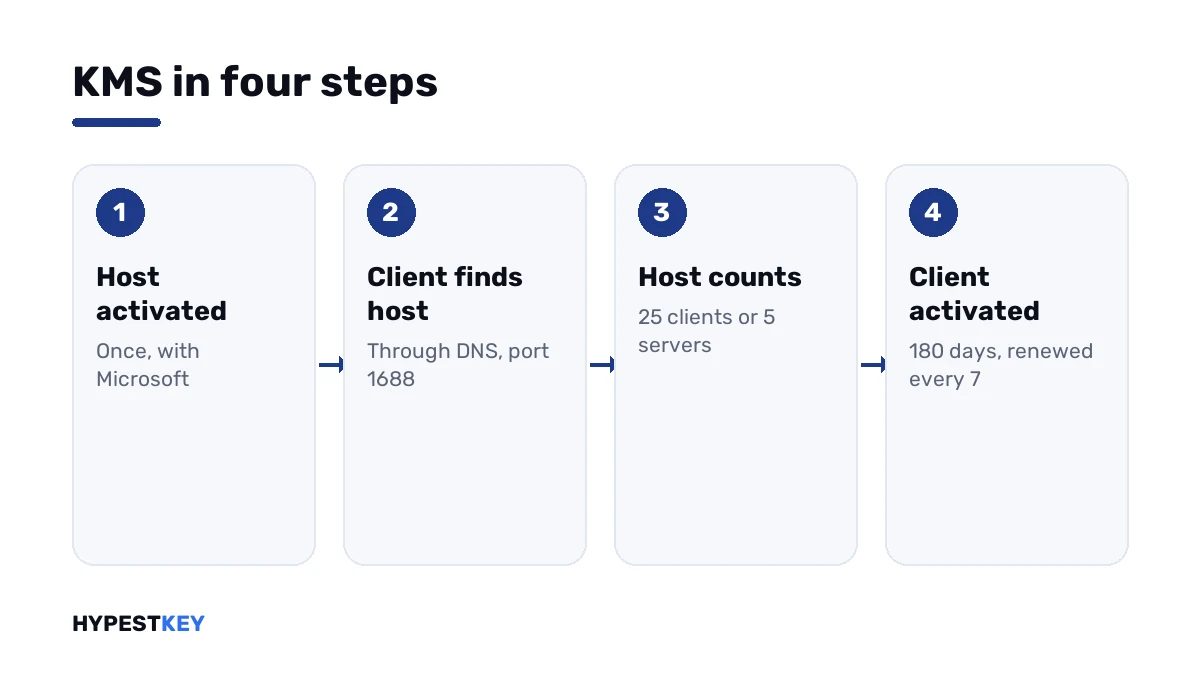
- The organisation sets up a KMS host on its own network.
- The host is activated once with Microsoft, using the organisation’s host key.
- Client PCs carry a public KMS client key and look for the host through DNS.
- The host counts the machines that ask. When the count is high enough, it activates them.
- Each activation is valid for 180 days, and clients renew long before that.
The host doesn’t have to be a dedicated machine. Microsoft says it can share a server with other services and can run on a physical or a virtual system.
The numbers
| Rule | Microsoft’s figure |
|---|---|
| Count needed for Windows clients | 25 or higher |
| Count needed for servers and Office volume editions | 5 or greater |
| Which connections are counted | Unique ones from the past 30 days |
| How many contacts the host remembers | The 50 most recent |
| Validity of an activation | 180 days |
| Default renewal attempt | Every 7 days |
| Default retry while not activated | Every 2 hours |
| Clients per host | Unlimited |
| Hosts recommended above 50 clients | At least two |
| Hosts one host key can activate | Six in total |
The floor of 25 is why small offices don’t use it. With twelve PCs the count never gets there, and every client shows 0xC004F038.
Host key and client key
Two different keys are involved, and mixing them up causes most KMS trouble.
| KMS host key | KMS client key | |
|---|---|---|
| Where it comes from | The organisation’s volume licensing portal | Microsoft’s public list |
| Goes onto | The KMS host | Every client |
| Activates with | Microsoft | The organisation’s host |
| Is it secret | Yes | No; it’s the same for everyone |
The client keys are the ones you find on “free key” pages. They’re real, and they do nothing without a host. Ours are listed with that warning on the generic keys page, and the Office ones on the Office keys page.
What a host can activate
A host activates the products its key covers. Microsoft’s table for that is long; this is the short form.
| Host key for | Covers |
|---|---|
| Windows Server 2025 | Server 2025 and earlier, Windows 11 and Windows 10 volume editions |
| Windows Server 2022 | Server 2022 and earlier, Windows 11 and Windows 10 volume editions |
| Windows Server 2019 | Server 2019 and earlier, Windows 10 volume editions |
| Windows 10 | Windows client editions only |
A host running on a Windows client system can only activate client systems. Office needs its own host key and license pack on top. A host that can’t serve a product answers with 0xC004F042.
How to check KMS activation on a PC
Three lines show whether a PC runs as a KMS client and how its activation stands.
- Open Command Prompt.
- Run the license line and read the description; VOLUME_KMSCLIENT marks a KMS client.
- Run the expiry line; a KMS client shows a date up to 180 days ahead.
- Run the detailed line to see the name of the KMS host that answered and the renewal interval.
- On a company PC without activation, connect to the office network or VPN first.
- Run the activation line from an administrator prompt.
- Read the expiry line again.
slmgr /dli
slmgr /xpr
slmgr /dlv
slmgr /ato| Line | What it shows on a KMS client |
|---|---|
slmgr /dli |
Channel VOLUME_KMSCLIENT and the license status |
slmgr /xpr |
“Volume activation will expire” with a date |
slmgr /dlv |
The KMS machine name, the port, and the activation and renewal intervals |
slmgr /ato |
Asks the host for activation now |
Every switch of the script is in our slmgr commands reference.
KMS, MAK and Active Directory
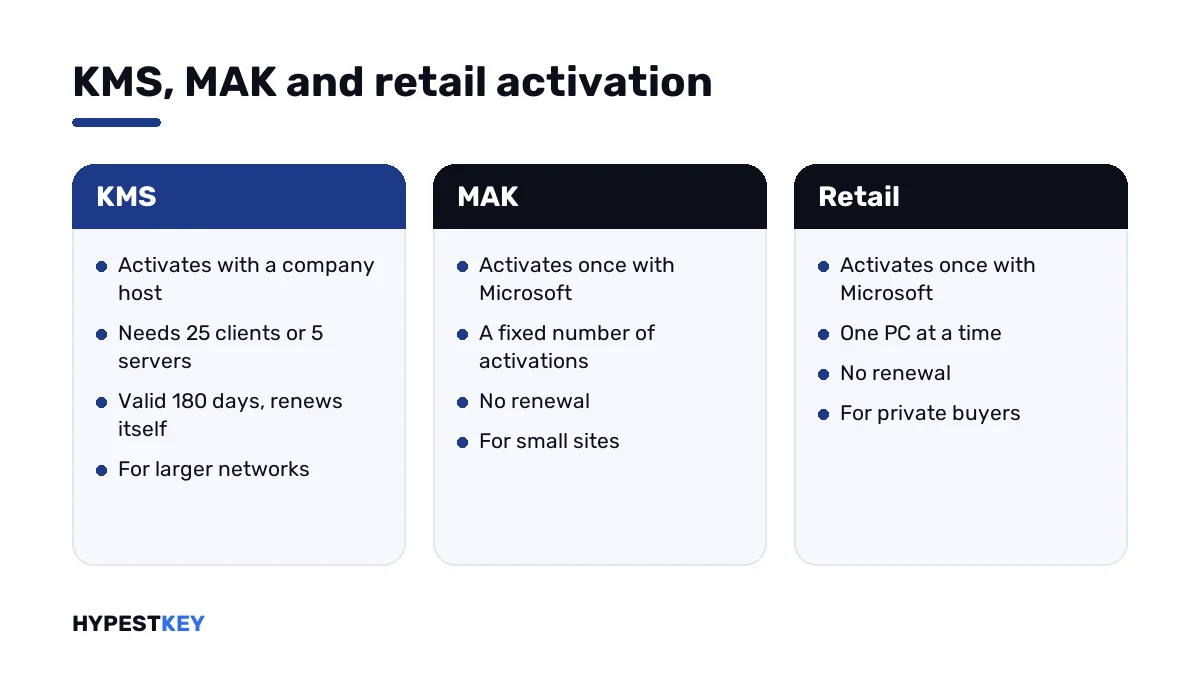
Organisations have three ways to activate volume licenses.
| KMS | MAK | Active Directory-based | |
|---|---|---|---|
| Activates against | A host on the company network | Microsoft, once per PC | The directory, for domain-joined PCs |
| Minimum number of machines | 25 clients or 5 servers | None | None |
| Renewal | Every 180 days at the latest | None | Like KMS, through the domain |
| Fits | Larger networks | Small sites and PCs that rarely see the office | Domains of any size |
How those compare with the licenses private buyers get is in Retail vs OEM vs Volume license.
On a home PC
A private PC has no KMS host, so KMS can’t activate it. If yours shows a volume channel or a KMS error, it carries a key that was meant for a company.
You’ll also meet “KMS activators” and public KMS servers online. They point your PC at a host that somebody else controls. That isn’t a license, it can stop any day, and the tools often carry malware.
The fix at home is short: a retail key for the installed edition.
slmgr /ckms
slmgr /ipk XXXXX-XXXXX-XXXXX-XXXXX-XXXXX
slmgr /ato
Need one? Ours are genuine and arrive instant to email: Windows 11 Pro and Windows 10 Pro. They activate with Microsoft directly and don’t expire.
When it fails
Each stage of a KMS request has its own code, which makes them a useful map.
| Stage | Code |
|---|---|
| No host found in DNS | 0x8007232B, 0x8007251D |
| No host could be contacted | 0xC004F074 |
| The host didn’t respond as KMS | 0xC004F039 |
| The host isn’t activated | 0xC004F041 |
| The count is too low | 0xC004F038 |
| The clocks differ too much | 0xC004F06C |
Everything else is in our list of Windows 11 activation errors. Server editions and their key types are in the Windows Server 2022 activation guide.
Mistakes we see most
- Treating a KMS client key as a free license.
- Planning KMS for an office with ten PCs.
- Putting the host key on clients.
- Pointing a private PC at a public KMS server.
- Reading the 180-day date as a problem on a company PC.
Terms used on this page
| Term | Meaning |
|---|---|
| KMS host | The organisation’s server that activates its volume-licensed machines |
| KMS client | A PC or server that asks the host for activation |
| Host key | The organisation’s key for the host; Microsoft’s formal name is CSVLK |
| Client key | A public key that makes a machine look for a KMS host |
| Activation threshold | The minimum count before the host activates anyone |
| Activation validity interval | The 180 days one activation lasts |
| MAK | A volume key that activates each PC once with Microsoft |
FAQ
What is KMS activation?
A way for organisations to activate volume-licensed Windows and Office through a server on their own network. That server, the KMS host, is activated with Microsoft once. I'd think of it as activation in bulk.
How long does KMS activation last?
180 days per activation, according to Microsoft. Clients try to renew every 7 days by default, and each renewal starts the 180 days again. On the company network, we never see it run out.
How many computers does KMS need?
The host activates Windows clients once its count is 25 or higher. Servers and Office volume editions need 5. Below that, every request is refused until more machines check in.
Can I use KMS activation at home?
No. KMS needs a host that the organisation runs and has activated with its own key. A home network has none. For a private PC, I'd use a retail key.
Is a KMS client key a free license?
No. The client keys are public and only tell a PC to look for a KMS host. Without a licensed host behind them they activate nothing. The license is the organisation's volume agreement.
What port does KMS use?
TCP port 1688 by default. Clients find the host through DNS and connect on that port. If activation fails inside a company, we'd check that the port is open between client and host.
Are public KMS servers and KMS activators safe?
I wouldn't use them. They point your PC at a server you don't control, they aren't a license, and the tools around them often carry malware. A genuine key for your edition ends the problem.