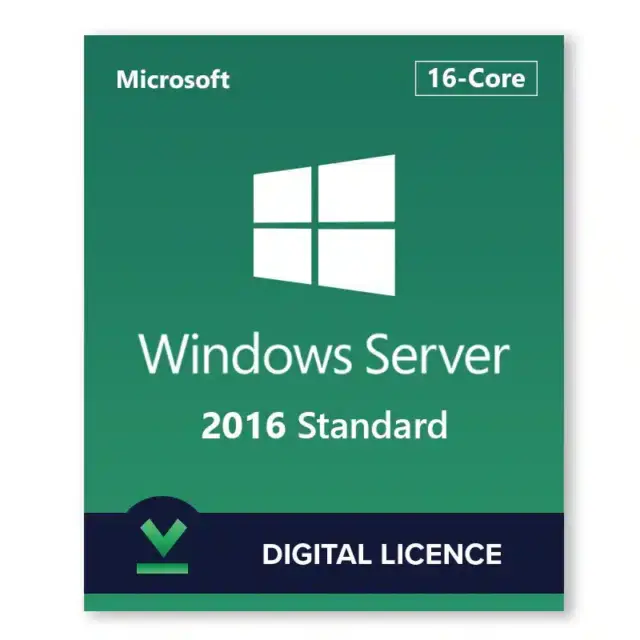





Windows Server 2016 Standard is Microsoft’s server operating system for physical or lightly virtualized servers that run Active Directory, file and print services, IIS, Hyper-V and Remote Desktop Services. A windows server 2016 standard key from HypestKey activates that edition with a perpetual license and a Microsoft download link. It suits businesses that keep 2016 for application compatibility, but plan ahead: Microsoft’s extended support ends January 12, 2027.
Key takeaways
- Standard edition rights: the physical host plus two virtual machines (OSEs) per fully licensed server.
- Licensed per physical core (minimum 8 per processor, 16 per server); client access needs CALs.
- Storage Spaces Direct, Storage Replica, Shielded VMs and Network Controller are Datacenter-only in 2016.
- Mainstream support ended January 11, 2022; security updates stop January 12, 2027.
- Key emailed instantly after payment, no account needed.
What does Windows Server 2016 Standard include?
Windows Server 2016 Standard includes every core server role: Active Directory Domain Services, DNS, DHCP, File and Storage Services with deduplication, IIS, Hyper-V, Failover Clustering, Remote Desktop Services, Windows Server Update Services and Windows Server Backup. It also brought Windows Server containers, nested virtualization, production checkpoints and Windows Defender built into the OS.
Two install options sit on the same media. Server with Desktop Experience gives the full graphical Server Manager and is the friendly choice for a first server. Server Core drops the GUI, needs fewer patches and less RAM, and is managed through PowerShell, Windows Admin Center or RSAT from another PC. You pick the option during setup and cannot switch between them later without reinstalling.
Which security features does 2016 add?
Windows Server 2016 added Credential Guard, which isolates domain credentials with virtualization-based security against pass-the-hash attacks, and Device Guard code integrity that limits which binaries may run. Just Enough Administration (JEA) gives admins only the PowerShell commands a task needs. Windows Defender Antivirus is installed and on by default.
Windows Server 2016 Standard vs Datacenter: what is the difference?
Windows Server 2016 Standard and Datacenter share the same core roles and are licensed per core. Standard covers the host plus two virtual machines per licensed server, while Datacenter covers unlimited VMs on that host. In the 2016 release, Storage Spaces Direct, Storage Replica, Shielded VMs and the SDN Network Controller exist only in Datacenter.
| Feature | Standard 2016 | Datacenter 2016 |
|---|---|---|
| Core roles (AD DS, DNS, DHCP, IIS, file services, RDS) | Yes | Yes |
| Hyper-V and Failover Clustering | Yes | Yes |
| Virtual machines (OSEs) per licensed server | 2 | Unlimited |
| Windows Server containers | Unlimited | Unlimited |
| Hyper-V containers | 2 | Unlimited |
| Storage Spaces Direct | No | Yes |
| Storage Replica | No | Yes |
| Shielded VMs (Host Guardian Hyper-V Support) | No | Yes |
| Network Controller (software-defined networking) | No | Yes |
Running three or more VMs on one host, or building a hyper-converged cluster? The Windows Server 2016 Datacenter key is the right fit. Feature data: Microsoft Learn, Windows Server editions comparison.
How is Windows Server 2016 Standard licensed?
Windows Server 2016 Standard is licensed per physical core. Microsoft requires every physical processor to have at least 8 core licenses and every server at least 16, sold in 2-core packs above that. Each user or device that connects also needs a Windows Server CAL, and Remote Desktop sessions need RDS CALs on top.
Count physical cores, not threads or virtual CPUs. Stacking a second full set of Standard core licenses on the same server adds two more VM rights, which is how small hosts often grow before Datacenter makes sense. Not sure what your hardware needs? Write to us before you order and tell us the CPU model and socket count.
- Server licenses: cover the OS on the physical host and its VM rights.
- Windows Server CALs: user or device based; see Windows Server 2016 Standard 5 user CALs.
- RDS CALs: needed for Remote Desktop Services sessions beyond the two admin connections.
Windows Server 2016 system requirements
Windows Server 2016 needs a 1.4 GHz 64-bit processor with NX, DEP and Second Level Address Translation, at least 1 GB of RAM for Server Core or 2 GB for Desktop Experience, 32 GB of disk and a gigabit Ethernet adapter. Real workloads, especially Hyper-V hosts, typically need far more memory and storage than these minimums.
| Component | Minimum (Microsoft) |
|---|---|
| Processor | 1.4 GHz 64-bit, x64 instruction set, NX and DEP, CMPXCHG16b, LAHF/SAHF, PrefetchW, SLAT (EPT or NPT) |
| Memory | 1 GB for Server Core; 2 GB for Server with Desktop Experience; ECC for physical hosts |
| Storage | 32 GB on a PCI Express compliant storage adapter (no PATA) |
| Network | Ethernet adapter with at least 1 Gbps throughput |
| Other | UEFI 2.3.1c and TPM for Secure Boot and BitLocker; 1024 × 768 display |
Source: Microsoft Learn, hardware requirements for Windows Server. Installing in a VM with only 512 MB fails; give the VM at least 800 MB during setup. For a Hyper-V host, plan the RAM of every guest plus a few gigabytes for the host itself.
How do I activate a windows server 2016 standard key?
Activate Windows Server 2016 Standard in Settings > Update & Security > Activation > Change product key, or from an elevated command prompt with slmgr /ipk followed by slmgr /ato. If the server runs the Evaluation edition, convert it first with DISM. Activation needs internet access or the phone option.
- Install Windows Server 2016 from the Microsoft download, choosing Windows Server 2016 Standard (Desktop Experience) or the Server Core option.
- Sign in as Administrator and open an elevated Command Prompt or PowerShell.
- Enter the key:
slmgr /ipk XXXXX-XXXXX-XXXXX-XXXXX-XXXXX - Activate online:
slmgr /ato - Check the result with
slmgr /dlv; it should show “License Status: Licensed”. - Offline server? Run
slui 4, pick your country and follow the phone activation steps.
On an Evaluation install, check the possible editions with DISM /online /Get-TargetEditions, then run DISM /online /Set-Edition:ServerStandard /ProductKey:XXXXX-XXXXX-XXXXX-XXXXX-XXXXX /AcceptEula and restart. Domain controllers cannot be converted this way; demote first. Our guide on activating Windows Server via DISM walks through each step.
Tip: run the DISM conversion before you add roles. The server restarts at least once, and doing it on a fresh install saves you from planning a maintenance window later.
How long is Windows Server 2016 supported?
Windows Server 2016 follows Microsoft’s Fixed Lifecycle Policy. It launched on October 15, 2016, mainstream support ended on January 11, 2022, and extended support with monthly security updates ends on January 12, 2027. After that date, servers get no more patches unless the organization buys Extended Security Updates from Microsoft.
In practice, 2016 suits servers that must stay on it for a line-of-business app, a vendor certification or old hardware, with a migration plan already on paper. In-place upgrades from Windows Server 2012 and 2012 R2 to 2016 are supported, and 2016 itself can upgrade in place to Windows Server 2019 or 2022. Building a new server today? The Windows Server 2022 Standard key stays supported until October 2031. Dates and options are in our Windows Server 2016 end of life guide.
Who is Windows Server 2016 Standard for?
Windows Server 2016 Standard fits small and mid-size businesses running a domain controller, file server, print server or a small Hyper-V host with up to two VMs. It also suits branch offices, test labs that mirror production on 2016, and software vendors that must certify their product on this exact version.
Typical setups look like this:
- One physical server as domain controller, DNS and DHCP, with a file share and print server.
- A Hyper-V host with two VMs: one for Active Directory, one for a line-of-business app or SQL Server.
- An RDS host for a handful of users (with RDS CALs).
- A staging server that matches a 2016 production estate before migration.
Delivery and support
HypestKey emails your Windows Server 2016 Standard key instantly after payment, with the Microsoft download link, and no account is needed. You pay by card, Apple Pay or Google Pay through Stripe. If the key does not activate, we help you fix it or send a replacement.
Questions about activation, editions or CALs go to support@hypestkey.com or the live chat. We handle key and activation issues; for deep role configuration, Microsoft Learn is the reference. All 2016 editions are listed in the Windows Server 2016 category. Something went wrong? We’ll help you fix it.
Delivery and activation
Visa, Mastercard and other cards, Apple Pay, Google Pay, processed by Stripe. Guest checkout, prices in USD.
Instant delivery to your email: the key is sent automatically as soon as your payment is confirmed. In rare cases (high demand or a fraud check) it can take up to 24 hours.
Check your spam folder first. Still no email? Write to support@hypestkey.com with your order number and we will resend it.
FAQ
How many virtual machines can I run with Windows Server 2016 Standard?
A fully licensed Standard server covers the physical host plus two virtual machines (OSEs). License the server's cores a second time for two more VMs, or choose Datacenter for unlimited VMs on that host.
How do I activate Windows Server 2016 Standard?
Open Settings > Update & Security > Activation > Change product key, or run slmgr /ipk with your key and then slmgr /ato in an elevated prompt. For an Evaluation install, convert first with DISM /online /Set-Edition:ServerStandard /ProductKey:... /AcceptEula.
Do I need CALs with Windows Server 2016 Standard?
Yes. Every user or device that connects to the server needs a Windows Server CAL, and Remote Desktop Services sessions need RDS CALs as well. Two admin Remote Desktop connections work without RDS CALs.
Does Standard 2016 include Storage Spaces Direct or Shielded VMs?
No. In Windows Server 2016, Storage Spaces Direct, Storage Replica, Shielded VMs and the Network Controller are Datacenter-only features. Standard includes regular Storage Spaces, Hyper-V and Failover Clustering.
When does support for Windows Server 2016 end?
Mainstream support ended January 11, 2022. Extended support, with monthly security updates, ends January 12, 2027. After that, only organizations that buy Extended Security Updates from Microsoft keep getting patches.
Can I upgrade Windows Server 2016 to a newer version later?
Yes. Microsoft supports in-place upgrades from Windows Server 2016 to 2019 and 2022, but each newer version needs its own license key. Back up the server and check application support before upgrading.
Can I install Windows Server 2016 Standard in a virtual machine?
Yes. It runs as a guest on Hyper-V, VMware and other hypervisors. Give the VM at least 800 MB of RAM during setup, because installs with only 512 MB fail.