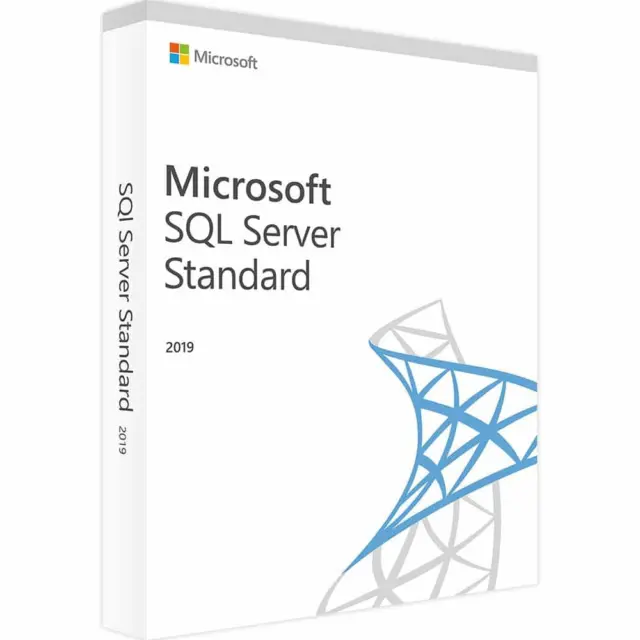




SQL Server 2019 Standard is Microsoft’s mid-range relational database edition for business applications, reporting and line-of-business data. A SQL Server 2019 Standard key from HypestKey is a one-time purchase that unlocks the Standard edition during setup, so you can run production databases without Enterprise pricing. It suits small and mid-sized companies, ISVs whose apps are certified for SQL Server 2019, and teams moving off SQL Server 2012 to 2016. Microsoft supports it with security updates until January 8, 2030.
Key takeaways
- Standard edition uses up to 24 cores (or 4 sockets) and 128 GB of buffer pool memory per instance.
- Database size limit is 524 PB, so data volume is rarely the constraint.
- Basic availability groups, TDE, Always Encrypted and row-level security are all in Standard.
- Mainstream support ended February 28, 2025; extended support with security fixes runs to January 8, 2030.
- Runs on Windows Server 2016, 2019, 2022 and 2025, plus Windows 10 and 11.
What Is SQL Server 2019 Standard Good For?
SQL Server 2019 Standard handles transactional databases, reporting and data integration for departments and mid-size companies. The free Express edition stops at 10 GB per database and one socket or four cores; Enterprise removes hardware limits at a much higher cost. Standard sits between them, covering up to 24 cores and 128 GB of buffer pool memory.
Typical jobs: an ERP or accounting system, a CRM backend, a web app database, scheduled reports through Reporting Services, nightly ETL with Integration Services. Need more than 128 GB of cache or more than 24 cores in a single instance? That is Enterprise territory. For almost everything else, Standard does the work.
What’s New in SQL Server 2019 Standard?
SQL Server 2019 brought Intelligent Query Processing features, Accelerated Database Recovery, UTF-8 support, Always Encrypted with secure enclaves and an expanded PolyBase. Several of these work in Standard: scalar UDF inlining, table variable deferred compilation and approximate count distinct are available in every edition, while batch mode on rowstore stays Enterprise-only.
- Scalar UDF inlining: scalar functions get rewritten into the calling query, which typically removes the row-by-row slowdown they caused before.
- Table variable deferred compilation: the optimizer uses real row counts for table variables instead of guessing one row.
- Accelerated Database Recovery: crash recovery and long rollbacks finish far faster, in Standard as well.
- UTF-8 collations: store Unicode text in
varcharcolumns. I’d waited years for that one. - PolyBase: since 2019, the PolyBase head node no longer requires Enterprise, so Standard can query external data sources through T-SQL.
- Hybrid buffer pool and persistent memory support for servers with PMEM hardware.
Upgrading code that leans on scalar functions? Test it on 2019 before you go live. Same code, same hardware, very different plans: that is often where the biggest gains show up.
Which Security Features Does SQL Server 2019 Standard Include?
SQL Server 2019 Standard includes Transparent Data Encryption, Always Encrypted (also with secure enclaves), row-level security, dynamic data masking and auditing. TDE in Standard is new with 2019; earlier versions reserved it for Enterprise. Together these cover encryption at rest, column-level encryption the DBA cannot read, and per-user row filtering.
- Transparent Data Encryption: encrypts data and log files on disk.
- Always Encrypted: sensitive columns stay encrypted in the database; keys remain with the client application.
- Row-level security: different users see different rows of the same table.
- Dynamic data masking: show partial values such as XXX-XX-1234 to non-privileged users.
- Vulnerability assessment in SQL Server Management Studio flags risky configuration.
Facing an auditor who asks whether administrators can read personal data? With Always Encrypted you can answer no, and show why.
SQL Server 2019 Standard vs Enterprise
SQL Server 2019 Standard and Enterprise share the same database engine, T-SQL and most security features. Enterprise lifts the 24-core and 128 GB memory caps, adds full Always On availability groups with readable secondaries, online index operations and batch mode on rowstore. Standard keeps basic availability groups with two replicas and one database each.
| Feature | Standard | Enterprise |
|---|---|---|
| Compute per instance | Lesser of 4 sockets or 24 cores | Operating system maximum |
| Buffer pool memory per instance | 128 GB | Operating system maximum |
| Maximum database size | 524 PB | 524 PB |
| Availability groups | Basic (2 replicas, 1 database) | Full Always On |
| Failover cluster instances | Yes (2 nodes) | Yes |
| Transparent Data Encryption | Yes | Yes |
| Batch mode on rowstore | No | Yes |
| Scalar UDF inlining | Yes | Yes |
Want the newer engine with the same Standard limits model? Compare with SQL Server 2022 Standard, supported longer. Keeping an app certified only for 2017? SQL Server 2017 Standard is also in stock.
How Is SQL Server 2019 Licensed?
Microsoft licenses SQL Server 2019 Standard in two ways: per core, or Server + CAL. Per core means licensing every physical core (or every virtual core of a VM) in two-core packs, with at least four core licenses per processor or VM. Server + CAL means one server license plus a Client Access License for each user or device.
Which one fits? Unknown or public users, such as a website or an API, point to per-core licensing. A fixed group of internal staff, say 30 people using a reporting database, often costs less with Server + CAL. CALs must be for SQL Server 2019 or newer; older SQL CALs don’t cover a 2019 server. Check Microsoft’s licensing terms for your exact setup.
SQL Server 2019 System Requirements
SQL Server 2019 needs an x64 processor at 1.4 GHz or faster (2.0 GHz recommended), at least 1 GB of RAM (4 GB or more recommended) and 6 GB of free disk space. It runs on Windows Server 2016, 2019, 2022 and 2025, and on Windows 10 and Windows 11, so it fits both current servers and developer workstations.
| Component | Minimum | Recommended |
|---|---|---|
| Processor | x64, 1.4 GHz | 2.0 GHz or faster |
| Memory | 1 GB | 4 GB or more, growing with database size |
| Disk space | 6 GB | SSD storage for data and log files |
| Windows Server | 2016, 2019, 2022, 2025 | |
| Windows client | Windows 10 (1507 or later), Windows 11 | |
Source: Microsoft Learn, SQL Server and Windows compatibility matrix and the SQL Server 2019 hardware and software requirements page. SQL Server 2019 also has Linux builds for Red Hat, SUSE and Ubuntu. Need a host OS too? Windows Server 2022 Standard pairs well with it.
How Do I Install SQL Server 2019 with My Key?
To install SQL Server 2019 Standard, run setup.exe from the Microsoft media, choose New SQL Server stand-alone installation, and enter your 25-character key on the Product Key page. The key selects the Standard edition. SQL Server has no separate online activation step, so once setup ends the instance is ready.
- Download the SQL Server 2019 media from the Microsoft link in your email, mount the ISO and run setup.exe as administrator.
- Choose Installation > New SQL Server stand-alone installation or add features to an existing installation.
- On the Product Key page, select Enter the product key and paste your key.
- Accept the license terms, then on Feature Selection tick Database Engine Services; add Full-Text Search or Integration Services if you use them.
- Pick a default or named instance, set service accounts (domain accounts on production servers), then choose Windows or mixed authentication and add your admin accounts.
- Click Install. Afterwards, apply the latest cumulative update and install SQL Server Management Studio separately.
Tip: Upgrading from SQL Server 2014, 2016 or 2017? Run Data Migration Assistant first. It flags deprecated features and breaking changes before you commit.
Keep the key email safe: you need the same key when you reinstall or move SQL Server 2019 to new hardware.
Is SQL Server 2019 Still Supported?
Yes, in extended support. Mainstream support for SQL Server 2019 ended on February 28, 2025, so Microsoft no longer adds features or non-security fixes. Extended support continues with security updates until January 8, 2030. That leaves several years of patched operation for apps that are certified for SQL Server 2019.
Planning something that must run past 2030? Pick SQL Server 2022 instead. Either way, browse every edition in our SQL Server category.
Delivery and Support
Your SQL Server 2019 Standard key is emailed instantly after payment, and no account is needed on our side. Most orders arrive within minutes; rarely, a fraud check delays one. For key, setup or edition questions, write to support@hypestkey.com or use the live chat. Something went wrong? We’ll help you fix it.
If the key is not accepted, HypestKey helps you fix it or sends a replacement. Deep database tuning questions belong with Microsoft documentation and the SQL Server community, where years of answers already exist.
Delivery and activation
Visa, Mastercard and other cards, Apple Pay, Google Pay, processed by Stripe. Guest checkout, prices in USD.
Instant delivery to your email: the key is sent automatically as soon as your payment is confirmed. In rare cases (high demand or a fraud check) it can take up to 24 hours.
Check your spam folder first. Still no email? Write to support@hypestkey.com with your order number and we will resend it.
FAQ
Standard vs Enterprise: what am I missing with Standard?
Mostly scale and high-end availability. Standard uses up to 24 cores and 128 GB of buffer pool memory per instance and offers basic availability groups (two replicas, one database). Enterprise removes those caps and adds full Always On availability groups, online index operations and batch mode on rowstore.
Where do I enter the SQL Server 2019 product key?
During setup. Choose New SQL Server stand-alone installation, and on the Product Key page select Enter the product key. The key selects the Standard edition; SQL Server has no separate online activation.
Can I upgrade from SQL Server 2017 to 2019 in place?
Yes. Microsoft supports in-place upgrades to SQL Server 2019 from earlier supported versions such as 2014, 2016 and 2017. Databases, logins and Agent jobs stay. Test on a non-production server first and run Data Migration Assistant.
Does SQL Server 2019 run on Windows Server 2022 or 2025?
Yes. Microsoft supports SQL Server 2019 on Windows Server 2016, 2019, 2022 and 2025, and on Windows 10 and Windows 11.
Is there a limit on the number of databases?
No practical one. Each database can grow to 524 PB, and you can create as many databases as you need. The 128 GB buffer pool cap is usually the real ceiling for performance.
Can I move SQL Server 2019 to a new server?
Yes, the same key reinstalls SQL Server 2019 Standard on new hardware. Uninstall it from the old server first so the license runs in one place, then back up and restore or attach your databases.
How long is SQL Server 2019 supported?
Mainstream support ended February 28, 2025. Extended support with security updates continues until January 8, 2030.