Short answer: The 0x80073712 error shows that the Windows component store is damaged, so an update can't install. We'd run DISM CheckHealth, then RestoreHealth and SFC, and retry. Still failing? Then we'd clear the update cache, install the KB by hand, or reinstall Windows over itself with Fix problems using Windows Update.
The 0x80073712 error is ERROR_SXS_COMPONENT_STORE_CORRUPT: the component store that Windows installs updates from is in an inconsistent state, so the update can’t finish. Your files are safe. We’d check the store with DISM, repair it, run SFC and retry the update before anything heavier.
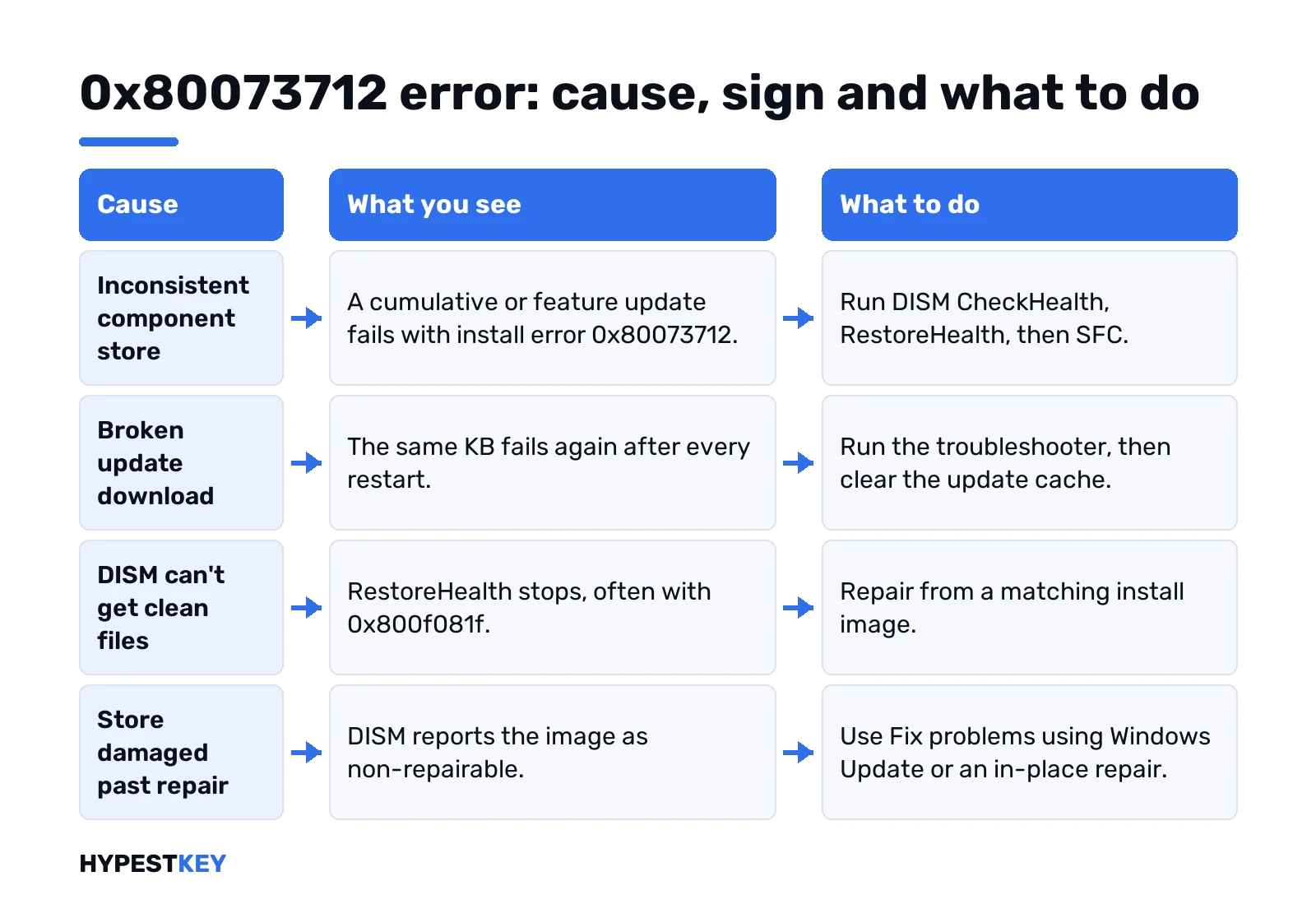
| Cause | What you see | What to do |
|---|---|---|
| Damaged or inconsistent component store | “Install error – 0x80073712” on a cumulative or feature update | DISM CheckHealth, RestoreHealth, then SFC |
| Incomplete or broken update download | Same KB fails after every restart | Troubleshooter, then clear the update cache |
| DISM can’t get clean files | RestoreHealth fails, often with 0x800f081f | Repair from a matching install image |
| Store damaged past repair | DISM reports the image as non-repairable | Fix problems using Windows Update or an in-place repair |
| Files deleted from WinSxS by hand or by a cleaner | Updates fail right after a “free up space” session | Repair install, then use only built-in cleanup |
What the 0x80073712 error means for your PC
Windows keeps every system component in the WinSxS folder. Updates install from it. Optional features and language packs too. Microsoft calls this the component store.
The error says the store doesn’t add up. Some file or manifest doesn’t match what Windows expects, so the servicing stack refuses to continue. On Microsoft’s update help page it shares a line with 0x800F081F. Corrupted or missing system files, or an incomplete download.
The PC keeps working. Only that update waits. Activation isn’t touched either.
Close relatives on the same list: error 0x800f081f, where the source files are missing, and 0x8007371b, where a transaction is incomplete.
Where 0x80073712 shows up
- Update history. “Install error – 0x80073712” next to a KB number.
- Monthly cumulative and security updates. The usual case.
- Feature updates to a newer Windows 11 version.
- Optional features and language packs, since they install from the same store.
- Windows Server patches. Same servicing stack, same code.
Note the KB number now. You’ll want it for the manual install later.
Fix 1: run the Windows Update troubleshooter
Low effort, so first. Windows 11 starts it from the Get Help app. Or Settings, System, Troubleshoot, Other troubleshooters, then Windows Update.
Windows 10 keeps it under Update & Security. Our Windows Update troubleshooter guide shows both menus. It resets update services, which helps when the download was the broken part. A corrupt store needs the next step.
Fix 2: check the store with DISM
Command Prompt, as administrator. A quick look first:
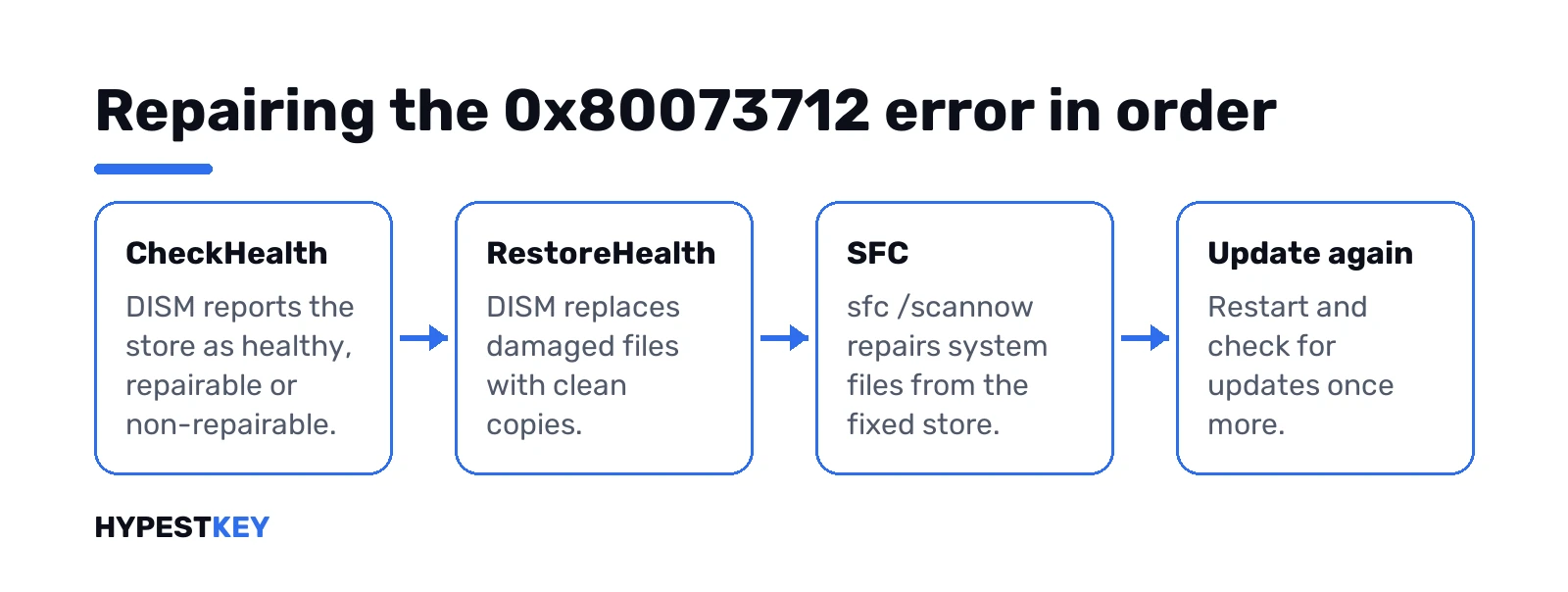
DISM /Online /Cleanup-Image /CheckHealthIt answers in one of three ways. Healthy, repairable or non-repairable. Want a deeper scan? This one takes several minutes:
DISM /Online /Cleanup-Image /ScanHealthRepairable? Good news. Go to the next step.
Non-repairable? Skip ahead to the repair reinstall. DISM won’t fix that one.
Fix 3: repair the 0x80073712 error with RestoreHealth and SFC
Same admin window. Then:
DISM.exe /Online /Cleanup-image /RestorehealthDISM fetches clean copies from Windows Update. Leave it alone, even if the percentage sits still for a while. Wait for “The restore operation completed successfully.” Then:
sfc /scannowOrder matters. SFC repairs system files from the store, so the store comes first. Restart, then Check for updates.
Both tools write to the CBS log. Handy later:
%windir%\Logs\CBS\CBS.logWhen RestoreHealth fails too
Offline PC, a proxy, a company WSUS server. DISM then has nowhere to get files from and stops, often with 0x800f081f. Give it a source.
We’d use a Windows ISO of the same version, edition and language. Download it with the Windows 11 Media Creation Tool and mount the ISO. Say it’s drive D, and index 6 is your edition:
DISM /Online /Cleanup-Image /RestoreHealth /Source:wim:D:\sources\install.wim:6 /LimitAccessNot sure about the index? Get-WimInfo lists them:
DISM /Get-WimInfo /WimFile:D:\sources\install.wimThe image has to be patched at least as far as your PC. An old ISO on a freshly updated system often misses files. Our 0x800f081f guide goes deeper into repair sources.
Fix 4: clear the update cache
Store repaired, same KB still fails? Then a half-downloaded package may be sitting in the cache. Admin Command Prompt, line by line:
net stop wuauserv
net stop bits
ren C:\Windows\SoftwareDistribution SoftwareDistribution.old
net start bits
net start wuauserv
Restart. Windows Update downloads everything fresh, so the first check is slower.
Third-party antivirus? We’d pause it for the retry and switch it back on after.
Install the failing update by hand
- Copy the KB number from Update history.
- Search it in the Microsoft Update Catalog.
- Choose your version and architecture. x64 for most PCs.
- Run the .msu file. Restart when it asks.
Wrong build picked? The installer says it doesn’t apply. No harm done, grab the other file. Large cumulative packages take time, and our piece on Windows 11 update time explains the wait.
Fix 0x80073712 with a repair reinstall
Non-repairable store, or nothing else worked. Then we’d reinstall Windows over itself. Apps and files stay.
Windows 11 has a button for this on recent builds. Settings, System, Recovery. Under Fix problems using Windows Update, press Reinstall now. Windows downloads a repair copy of your current version and keeps apps, files and settings. Windows Update itself may suggest it after a failure like this one.
Stay plugged in and online until it’s done. Work PCs managed by IT may not show the option.
No button? The classic in-place upgrade does the same:
- Free at least 20 GB on 64-bit Windows.
- Mount a current ISO, run setup.exe.
- Change what to keep. Keep personal files and apps.
- Install, then sit through a few restarts.
We’d set a restore point in Windows 11 first. A factory reset or a clean installation stay as last options, after a backup.
Keep WinSxS healthy after the fix
WinSxS looks huge. Tempting to clean by hand. Don’t. Microsoft warns that deleting files there can leave a PC unable to boot or update.
Built-in cleanup is fine. Disk Cleanup with system files has an option for old updates. Or, admin prompt:
Dism.exe /online /Cleanup-Image /StartComponentCleanupWe’d skip third-party registry or “system” cleaners that touch WinSxS. And leave ResetBase alone unless you’re sure, since installed updates can’t be removed after it.
After the repair: check activation
A repair reinstall keeps the license. A clean install may ask again. Settings, System, Activation tells you, and our guide to check Windows activation status explains each message.
Clean install on a PC without a license? Our Windows 11 Pro key is Retail, instant to email.
Related guides
FAQ
will fixing 0x80073712 delete my files
Nope. DISM, SFC and Fix problems using Windows Update all keep your files and apps.
dism says the image is not repairable
Then skip further DISM runs. Reinstall now under Recovery, or an in-place upgrade, rebuilds the store.
can i just delete the winsxs folder
No. Microsoft warns it can stop Windows from booting or updating. Use Disk Cleanup or StartComponentCleanup instead.
how long does restorehealth take
Several minutes, and Microsoft says as much. Let it finish even when the percentage pauses.
is it safe to rename softwaredistribution
Yes, once the update services are stopped. Windows builds a new folder and downloads updates again.
does this error affect activation
Nope. It's a servicing problem, so the license and activation state stay exactly as they were.