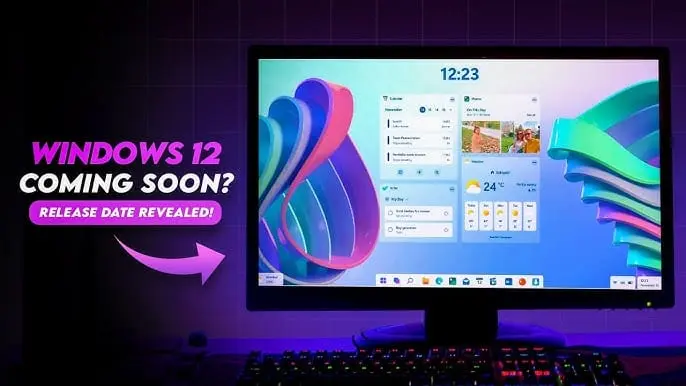
Short answer: There's no Windows 12 release date. As of November 2026, Microsoft hasn't announced the product at all. Its latest release is version 26H2 of Windows 11, out since September 29. So we'd expect a new Windows in 2027 at the earliest.
There’s no Windows 12 release date yet. As of November 2026, Microsoft hasn’t announced the product, named it or published requirements for it. What it shipped on September 29 is version 26H2 of Windows 11. Its published roadmap covers only versions of Windows 11.
Ahead of Build 2026, Windows chief Pavan Davuluri said the announcements wouldn’t include a new OS. Windows Latest reported that.
So the honest answer is 2027 at the earliest, and quite possibly later.
Each of the last three years was supposed to be the year. Each time, Microsoft pushed another update to the current system.
| Year | What arrived |
|---|---|
| 2024 | 24H2, with the Copilot+ PC features |
| 2025 | 25H2 |
| 2026 | 26H2, this autumn |
They’re stretching Windows 11 for as long as it works. XP had a long run too.
- Microsoft hasn’t confirmed Windows 12. Every “release date” online is speculation.
- Version 26H2 reached general availability on September 29, 2026.
- Any “Windows 12 ISO”, key or pre-order sold today is fake.
The Windows 12 release date
It doesn’t exist, because Microsoft has never announced the product. The company’s published roadmap covers only versions of Windows 11.
| Roadmap entry | Who it’s for |
|---|---|
| 26H1 | New devices |
| 26H2 | Everyone else |
A fresh version in 2027 is possible, but nothing from Microsoft points to a specific month or year.
No one outside Microsoft knows. That’s the truth, even if dozens of sites print confident dates.
Windows 11 came out in October 2021. Microsoft had announced it in June of the same year, about four months earlier.
We’d expect a similar gap, since announcements generally come a few months before launch.
If Microsoft unveils a successor at an event, the clock starts then, not before.
| Version | Released |
|---|---|
| Windows 11 24H2 | October 1, 2024 |
| Windows 11 25H2 | September 30, 2025 |
| Windows 11 26H1 (new devices only) | February 10, 2026 |
| Windows 11 26H2 | September 29, 2026 |
| Windows 12 | Not announced |
The dates for released versions come from Microsoft’s Windows 11 release information page.
Microsoft notes there that 26H1 is only for devices that started shipping in early 2026. It isn’t offered as an update to existing PCs.
Why it hasn’t come out yet
Microsoft chose to deliver its features, AI tools included, as updates to the current system. It didn’t want a separately branded release.
Many PCs were still moving off Windows 10, and Copilot+ hardware was fresh on the market. Another OS would have split users again.
No delay happened, since no date ever existed.
The year 2024 looked right. Rumors pointed to a three-year cycle.
| System | Released |
|---|---|
| Windows 10 | 2015 |
| Windows 11 | 2021 |
| Year | What Microsoft shipped |
|---|---|
| 2024 | 24H2 with Copilot+ PC features |
| 2025 | 25H2, delivered as a small enablement package on the same code base |
| 2026 | 26H1 for new Arm and x86 devices, and then 26H2 for everyone |
Hardware is part of the reason. Windows 11 required TPM 2.0 and processors on Microsoft’s list, and millions of PCs couldn’t move up.
Businesses stuck with Windows 10 because replacing hardware costs money. Microsoft saw what happened.
Pushing another hardware jump so soon would have repeated the same pain.
The “Windows 11 refresh” talk and the Build 2026 comments came from Microsoft executives and press coverage. No product announcement stood behind them. Until Microsoft posts a Windows 12 page of its own, we’d treat every date you read as an estimate, ours included.
When a Windows 12 release could realistically arrive
The realistic answer is no earlier than 2027, and only if Microsoft announces it first.
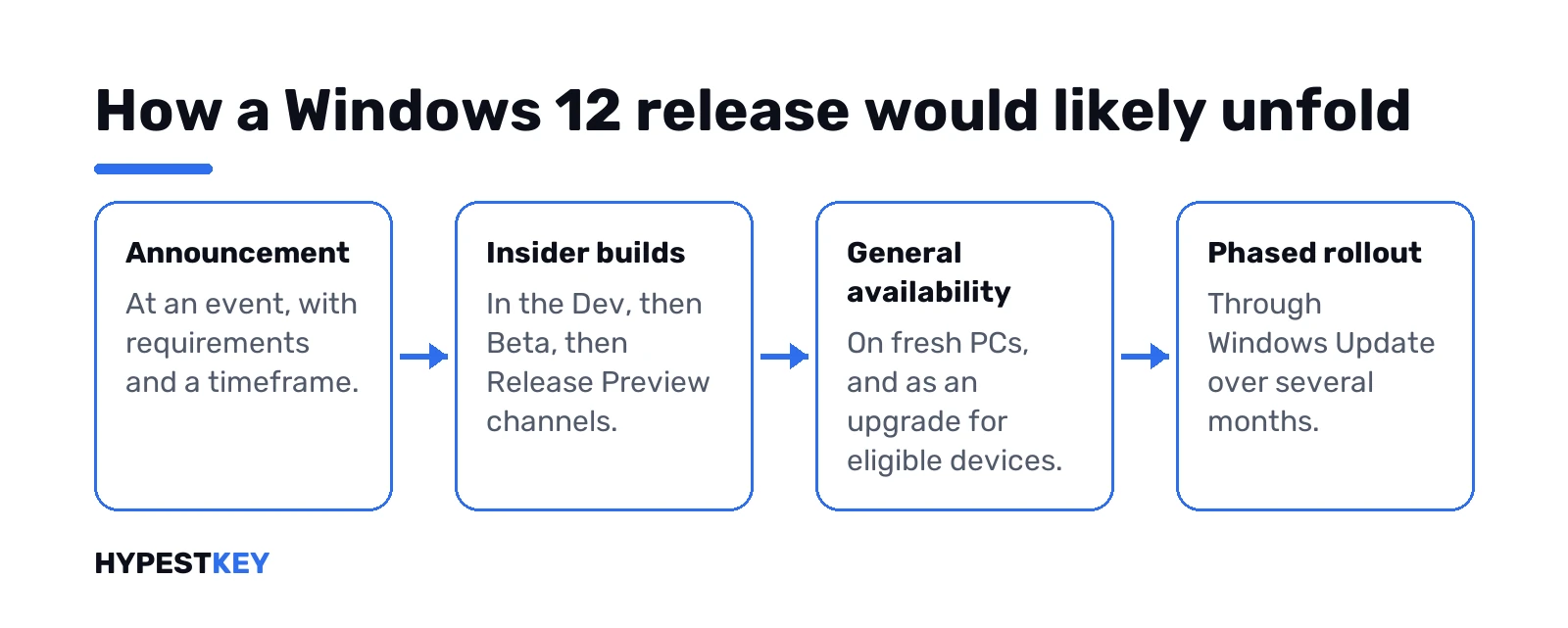
Microsoft has typically shipped a yearly update each autumn. A successor would most likely follow an announcement, Insider testing and then a gradual rollout.
That’s how Windows 11 arrived.
Count the signals. Version 26H2 has just launched, and Microsoft usually overlaps versions.
So a successor would most likely land while the current versions are still in service, not after.
That points to 2027 or 2028 as the earliest window, and it could be later.
It could also arrive as “Windows 11” with a fresh version number and no change of name at all.
If a successor does come, the pattern is predictable.
- An announcement at an event, with requirements and a timeframe.
- Insider builds in the Dev, then Beta, then Release Preview channels. The Windows Insider Program is free, so expect bugs.
- General availability on fresh PCs, and as an upgrade for eligible devices.
- A phased rollout through Windows Update over several months.
Windows 12 release date: 2026, 2027, 2028 or 2029?
All four years get searched. Here’s how each one holds up against what Microsoft has actually shipped.
| Year | How likely | Why |
|---|---|---|
| 2026 | Ruled out | The autumn release was Windows 11 26H2 on September 29, and no new Windows has been announced |
| 2027 | The earliest realistic year | Only with an announcement in the first half of the year, a few months before launch |
| 2028 | Possible | Fits the long gap between Windows 10 and Windows 11 |
| 2029 | A pure guess | Nothing from Microsoft points this far out |
History helps a little. Two launches to compare:
| Version | Launch date named | Released |
|---|---|---|
| Windows 10 | June 1, 2015 | July 29, 2015 |
| Windows 11 | Unveiled in June 2021 | October 5, 2021 |
| Windows 12 | Not announced | No date |
Six years and two months between those two. Add the same gap to October 2021 and you land in late 2027. One data point, though. Not a forecast.
Reddit threads and videos with a firm month? Usually traced back to a rumor site. We’d wait for Microsoft, since the Windows 10 date came about two months ahead of launch and Windows 11 was shown about four months ahead.
Want the next one after that? Our Windows 13 release date page tracks it separately.
What it might look like
Nothing about the design is confirmed. What exists are reports and Insider experiments.
| Report | Where it comes from |
|---|---|
| The codename “Next Valley” | Reported in 2023 |
| A modular “CorePC” project | Reported, never announced |
| A floating taskbar | A mock-up shown in a 2022 Microsoft keynote |
Most of the AI features people attribute to it already ship on Copilot+ PCs today.
Microsoft keeps things quiet until it’s ready. Before Windows 11 was announced, a build showed up online.
Nothing comparable has appeared this time. Screenshots pop up, people analyze code, and Microsoft says nothing.
AI features that already exist
The AI features most often linked to a successor are already here on Copilot+ PCs. Those need an NPU of 40+ TOPS.
| Feature | What it does |
|---|---|
| Recall | Searches snapshots of past activity |
| Cocreator in Paint | Generates images |
| Live Captions | Can translate audio into English captions |
| Windows Studio Effects with Voice Clarity | Cleans up calls |
Recall gets the most attention. Your PC saves snapshots of your activity, and you can search through them later.
“Find that email from last Tuesday” becomes a real request you can make.
It can feel creepy. Microsoft made it opt-in, and the snapshots are processed and stored locally.
A future system would likely build on these features, not reinvent them.
CorePC
CorePC is reported as a Microsoft project that was never announced. It would split the system into isolated, separately updatable parts.
System files would sit in a protected, read-only area. In theory that brings smaller updates, faster resets and easier rollback.
Some of those goals already show up today, through smaller enablement packages and quick machine recovery.
Anyone who has had an update break a computer sees the appeal. A modular design would let you roll back the broken piece and keep the rest.
It’s anyone’s guess if that becomes “Windows 12” or just the next update.
A new look
A redesign is plausible but unconfirmed. A 2022 Microsoft keynote showed a mock-up, and that started the rumors.
| What the mock-up showed |
|---|
| A floating taskbar |
| A search bar at the top of the screen |
| Fresh system icons |
Since then Microsoft has refined the Start menu and dark mode of the current system. It hasn’t shipped that design.
The Start menu in recent updates shows the apps you use first and recent files faster. Dark mode now reaches more legacy dialogs.
In short, the look keeps evolving one update at a time.
Windows 12 system requirements
Microsoft has published none. The best guide is today’s baseline, in two tiers.
| Component | Windows 11 minimum | Copilot+ PC (AI features) |
|---|---|---|
| Processor | 1 GHz, 2+ cores, 64-bit, on Microsoft’s CPU list | Chip with an NPU of 40+ TOPS (for example Snapdragon X, AMD Ryzen AI 300, Intel Core Ultra 200V) |
| Memory | 4 GB | 16 GB DDR5 or LPDDR5 |
| Storage | 64 GB | 256 GB SSD or UFS |
| Firmware and security | UEFI, Secure Boot capable, TPM 2.0 | Same |
| Graphics | DirectX 12 compatible, WDDM 2.0 driver | Same |
Anything stricter is guesswork. A successor would almost certainly start from these two tiers.
For the full list and a way to check your PC, see our Windows 11 requirements guide.
If TPM or Secure Boot is the blocker, our page on enabling Secure Boot covers the firmware settings.
Can your computer run it
Nobody can say for certain until Microsoft publishes requirements. A PC that runs Windows 11 well today is the safest bet.
Microsoft rarely raises the floor right after a big hardware jump. An NPU will likely matter only for AI features, as it does now.
| Your PC | Where it stands |
|---|---|
| A laptop from 2022 or 2023 on Windows 11 | Runs today’s system fine, without Recall or Cocreator |
| A Copilot+ machine from mid-2024 onward | Gets every AI feature |
| A desktop with a decent graphics card | Games and regular apps mostly don’t care about an NPU |
These all run with no NPU at all.
- Photoshop
- Chrome
- Steam
- Office
Being on Windows 10 is the real problem, not Windows 12. Our Windows 11 vs Windows 10 upgrade guide explains the move.
A free upgrade or not
Microsoft has said nothing about pricing. Precedent points toward a free upgrade for licensed users.
The last move between systems has been free on eligible hardware since 2021.
The license edition carried over. The real limit was hardware, not the license, and we’d expect that to repeat.
Under the current rules, Pro stays Pro and Home stays Home when you upgrade.
Our Windows 11 Home vs Pro comparison shows what each edition includes.
Need a key? Our Windows 11 Pro key comes as a genuine license. We email it instantly after payment, and it works on 26H2 today.
What to do before it arrives
Don’t wait for an OS that hasn’t been announced. Stay on a current version, which today is 25H2 or 26H2.
Keep Windows Update running. Buy hardware that meets Copilot+ specs only if you want the AI features.
Leaving Windows 10 now matters far more than timing a launch.
| Where you are | What to do |
|---|---|
| On Windows 10 | Move to Windows 11 |
| On Windows 11 24H2 | Install 26H2 from Settings > Windows Update |
| On 25H2 or 26H2 | Stay put. Any future version will appear in Windows Update when your PC is eligible |
| Buying a laptop | 16 GB RAM, an SSD and an NPU keep it relevant for years |
| Building a desktop | Focus on CPU and GPU. The NPU matters less on a machine that sits plugged in |
| Keeping your PC | Turn on TPM 2.0 and Secure Boot in firmware, and run Windows Update until nothing more appears |
We’d ignore anything sold as a “Windows 12 key”, a “Windows 12 ISO” or a pre-order. Microsoft has released nothing to sell, and such downloads are a common way to spread malware. Curious about the version after that? Our Windows 13 release date page covers the wilder rumors.
Common mistakes about the Windows 12 release date
- Believing a site that prints a confident date.
- Downloading a file that claims to be the next system.
- Paying for a pre-order or a key for a product that doesn’t exist.
- Putting off the move from Windows 10 to wait for it.
- Buying an NPU laptop only because of rumors.
- Assuming a PC that fails today’s requirements will pass the next ones.
Terms used on this page
| Term | Meaning |
|---|---|
| NPU | Neural processing unit, a chip part for AI work |
| TOPS | Trillions of operations per second, the speed measure for an NPU |
| Copilot+ PC | A PC with an NPU of 40+ TOPS, 16 GB of RAM and 256 GB of storage |
| Recall | The opt-in feature that searches snapshots of past activity |
| Enablement package | A small update that switches on features already on the disk |
| Windows Insider Program | Microsoft’s free channel for testing early builds |
| General availability | The day a version is released to everyone |
| CorePC | A reported project to split the system into separately updatable parts |
| TPM 2.0 | The security chip or firmware today’s system requires |
| ISO | A single file that holds a whole install disc image |
Typical questions while the Windows 12 release date is unknown
A Windows 12 pre-order on another site
Not real. Nothing announced, nothing to take orders for. A listing like that sells something else under a borrowed name. What a store can genuinely sell today? A Windows 11 Pro key. Or the Home edition.
An ISO named Windows 12 on a forum
Fake, and a common carrier of malware. Microsoft has published no build under that name, not even for Insiders. A PC that ran one needs a clean reinstall from Microsoft’s own media. New passwords too.
Staying on Windows 10 until Windows 12 arrives
Waiting for a version with no date means waiting with no end. An eligible Windows 10 PC can move to Windows 11 now. Our Windows 11 vs Windows 10 guide helps with that call.
No NPU in a gaming desktop
Games don’t use the NPU. Today a 40+ TOPS NPU matters only for Copilot+ features such as Recall, not for installing Windows 11. The budget stays with the graphics card.
Sources for the Windows 12 release date
| Item | Source |
|---|---|
| Release dates of versions | Microsoft’s Windows 11 release information page |
| The Build 2026 comment | The Windows Latest report on Pavan Davuluri’s statement |
| Status of this page | As of November 2026 |
FAQ
When is Windows 12 coming out?
Nobody outside Microsoft knows. Microsoft hasn't announced it, and its roadmap covers only versions of the current system. We'd treat 2027 as the earliest realistic window, and it could be later.
Has Microsoft officially announced Windows 12?
No. Ahead of Build 2026, Windows chief Pavan Davuluri said the announcements wouldn't include a new operating system. Microsoft shipped version 26H2 of Windows 11 in September instead.
Will Windows 12 be free for Windows 11 users?
Microsoft has said nothing about pricing. The move from Windows 10 to Windows 11 was free on eligible hardware. So we'd expect a free upgrade for licensed users, but it isn't confirmed.
Do I need an NPU to run Windows 12?
No requirements exist yet. Today an NPU of 40+ TOPS is needed only for Copilot+ AI features such as Recall. It isn't needed to install Windows 11, and we'd expect a successor to follow the same split.
Should I wait for Windows 12 or upgrade to Windows 11 now?
Upgrade now if you're on Windows 10. We wouldn't wait for a system that hasn't been announced.
Is it safe to download a Windows 12 ISO?
No. Microsoft has released no Windows 12 build. So any ISO, key or pre-order under that name is fake and often carries malware. We'd get Windows only from Microsoft's own download pages.
So, 2027 or 2028?
Depends on an announcement nobody has made yet. 2027 is the earliest realistic year. 2028 fits the gap between Windows 10 and Windows 11. Anything firmer is a guess.