
 Microsoft Windows
 Microsoft Office
 Office for Mac
 Windows Server
Listen, I’ll tell you straight. No windows 13 release date currently exists. Nothing from Microsoft at all. Not on any roadmap deck, not as a conference tease, not as an ISO floating around to OEM partners. This entire Windows 13 thing is vaporware right now. What they ARE shipping in 2026 is more Windows 11, specifically 26H2 this October. Below I’ll walk through what Microsoft has said on the record, what’s really on the 2026 roadmap, why those “Windows 13 LEAKED” videos on YouTube are bogus, and why waiting is a bad move right now.
TL;DR: The Windows 13 Release Date in One Paragraph
Zero windows 13 release date anywhere. No Microsoft announcement, no real leaks, no Insider build to poke at. If you’re on Windows, you’re on 25H2 right now, and 26H2 drops in October 2026. Microsoft’s last word on all this dropped in a November 2025 blog post: Windows 11 keeps getting yearly updates. Period. Expect no Windows 13 before 2028 at the earliest, and honestly? They might skip the “13” name entirely when that day comes.
Key Takeaways
- Microsoft has said zero about Windows 13. April 2026, earlier, same story everywhere.
- Right now you should be on Windows 11 25H2 (build
26200). 26H2 hits this coming October. - 26H1 is the strange one in the lineup. February 2026, Snapdragon X2 ARM hardware only. Your current desktop or laptop isn’t getting it.
- Exact Microsoft quote from their blog on November 7, 2025: “Windows 11 continues to have an annual feature update cadence.” That’s the latest they’ve said on this. No caveats.
- Those “Windows 13” YouTube clips? Three things: design mockups pretending to be real, Windows 11 with a skin on top, or malware disguised as an ISO file.
- If you need Windows, buy 11. It’s covered through October 2031.
- They skipped 9 once before. Same thing could happen with 13. Whatever comes after Windows 11 might not even be a “13” at all.
What Microsoft Has Officially Said About Windows 13
Nothing. At all. And that nothing is what tells you the most.
I spent maybe two hours going through everything I could find. Official Windows Blog posts, Insider Program announcements, the release health page on Microsoft’s own docs site, all the roadmap slides that have leaked in the past 24 months. Windows 13 doesn’t show up once. Every communication Microsoft put out in 2025 or 2026 was about Windows 11 updates, Copilot+ silicon, or AI. Not a single sentence mentions a successor. Nadella hasn’t said it. Build didn’t announce it. Silence.
The nearest thing we have to an official statement dropped on November 7, 2025. Came from the Windows team’s own blog. Direct quote: “Windows 11 continues to have an annual feature update cadence, with releases in the second half of the calendar year.” Read it twice if you need to. It commits to Windows 11. Doesn’t even hint at a next version.
Why am I hammering this? Windows has been a rolling service since about 2015, and version numbers stopped meaning anything engineering-wise. Shipping a “Windows 13” today is a brand-team decision, nothing more. Somebody in Redmond marketing would need to greenlight the whole launch-moment story. They haven’t pulled that trigger.
The Real Windows Roadmap for 2026 and 2027 (Still No Windows 13 Release Date)
Ignore the rumor blogs. What’s below is the actual public record. Want to double-check? Hit Win+R, type winver, compare what pops up with Microsoft’s release health page. Should line up.
| Release | Status | Release Date | Purpose |
|---|---|---|---|
| Windows 11 24H2 | Shipped | October 2024 | Major Copilot+ integration, Recall, Germanium platform |
| Windows 11 25H2 | Shipped | October 2025 | Enablement package, AI tweaks, Start menu changes |
| Windows 11 26H1 | Shipped (limited) | February 2026 | ARM-only release for new Snapdragon X2 PCs |
| Windows 11 26H2 | In preview | October 2026 | Enablement package, File Explorer Copilot, platform fixes |
| 2027 release | Planned | Late 2027 | Unification of 26H1 and 26H2 platforms |
| Windows 13 / successor | Not announced | 2028 or later (estimated) | Unknown |
About 26H1, it deserves a quick explainer because the setup is unusual. Ships pre-installed on new Snapdragon X2 PCs. The N1X from Nvidia will get it whenever those chips hit shelves. If you’re already running Windows 11 on whatever hardware, you don’t get 26H1. Can’t install it. It’s not in Windows Update, not on the Update Catalog, nowhere. Microsoft confirmed all this in a support document they posted in November of last year.
Why am I bringing up 26H1 in a windows 13 release date post? Because it tells you something. Microsoft is running two Windows codebases in parallel for roughly the next 12-18 months. ARM build for new silicon, x64 build for every other PC out there. They plan to merge both back into one in 2027. That alone is a massive engineering lift. Now imagine stacking a brand-new Windows 13 project on top of both of those. The dev teams would straight up collapse. Not realistic.
Windows 13 Release Date Rumors: A Timeline of What Leaked When
Windows 13 as a conversation online has been noisy going back a few years. Bad leaks, random analyst takes. Below is what really happened, chronologically:
- 2022: Some Insider builds had leftover strings referencing a post-Windows 11 release. Blogs saw that and immediately started running “Windows 12 or Windows 13” headlines. Microsoft stayed silent the whole time.
- Mid-2023: A Qualcomm slide deck got loose online. It had “Windows 12” sitting next to a new Snapdragon roadmap. Someone else attached the codename “Hudson Valley” to the story. Tech blogs ran with it for about a week straight.
- Late 2023: Both Windows Central and Windows Latest ran stories about Windows 12 rumors pointing to late 2024. Fall timeframe per their unnamed sources.
- October 2024: No Windows 12. Instead, 24H2 landed with the codename
Germanium. Completely different direction from what the leaks said. - 2025: 25H2 (build
26200) went out as an enablement package. November 7 brought that blog post confirming annual Windows 11 updates were the plan going forward. - February 10, 2026: 26H1 shipped to Snapdragon X2 machines through
KB5077179. A couple weeks earlier, on January 27, 26H2 previews started rolling through the Dev Channel as the26300build series. - April 2026 (where we are now): No 12, no 13. YouTube cranks out new “concepts” every few weeks. Microsoft couldn’t care less.
Look at that timeline end to end. The pattern is obvious. Every single “leak” over the past three years was either: (a) somebody confusing a Microsoft internal build number for a retail product name, or (b) somebody inventing a story for YouTube views. No exceptions.
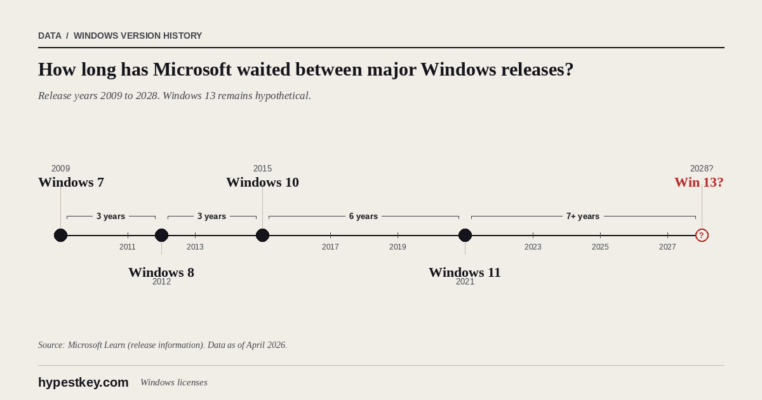
Windows Version History: What the Pattern Tells Us About a Windows 13 Release Date
Numbered Windows releases have never been on a fixed schedule. Gap lengths vary wildly. Still, the pattern gives you a rough number for when a realistic windows 13 release date might happen:
| Windows Version | Release Date | Gap from Previous |
|---|---|---|
| Windows 7 | October 2009 | 3 years (from Vista) |
| Windows 8 | October 2012 | 3 years |
| Windows 10 | July 2015 | 3 years (skipped 9) |
| Windows 11 | October 2021 | 6 years |
| Windows 12 / 13? | 2028 or later | 7+ years from Win 11 |
Few points stand out from the history above. The 10-to-11 gap was a full six years, and that was while Microsoft was loudly telling everyone numbered versions were over. With 26H2 coming this October and then the codebase merger in 2027, a realistic brand-new numbered Windows can’t happen before 2028. Maybe later. Honestly, could be 2029 or 2030, nobody can say for sure.
Also worth remembering: Microsoft skipped Windows 9 completely. Went 8.1 straight to 10. Half that decision was technical, old apps doing version checks with code like if (version.startsWith("Windows 9")) would false-match on 95 and 98 and bug out. Other half was pure marketing. Could they skip 13 the same way? Totally possible. Plenty of brands avoid 13 (airlines with row 13, hotels with floor 13, some hospital wings). Microsoft’s marketing folks definitely think about this stuff. For whatever might bridge 11 and whatever-comes-next, I’ve got a separate post on the Windows 12 release date question.
Why All the “Windows 13” Videos Online Are Fake
People get scammed by this, so I’ll just be direct. Search YouTube for “Windows 13” and you’ll see hundreds of results. Titles like “Windows 13 First Look” or “Leaked Windows 13 Build!” or the all-caps “INSTALL WINDOWS 13 NOW” variety. Fake. All of them. Zero exceptions. Saying it gently wouldn’t help anyone.
No Windows 13 build has been released by Microsoft anywhere. ISO? No. Insider preview? No. Internal demo at an all-hands? No. OEM partner preview under NDA? Also no. So if nothing exists, nothing can leak. Which means whatever’s in those videos falls into one of three buckets:
- Design mockups. Some designer builds out a Figma file picturing what they’d like Windows 13 to look like, records their screen zooming around it, uploads that as a “concept demo.” Harmless enough, just bait for views.
- Modified Windows 10 or 11 installs. Take a normal Windows machine, load up a custom theme, change out the taskbar, maybe drop in StartAllBack or similar. Call it “Windows 13” in the video thumbnail. It passes for real in a screenshot. But underneath, it’s just Windows 11 with makeup.
- Malware, straight up. This one costs people real money. Sketchy sites host “Windows 13 ISO” downloads, you grab one, and what ends up running is a malware installer. Sometimes a cryptominer, sometimes ransomware. Not a hypothetical. Browse the Microsoft Q&A forum, going back two or three years there are threads from victims who installed one of these and got absolutely wrecked.
Windows only comes from Microsoft. The Insider Program, the Microsoft Update Catalog, and microsoft.com/software-download. That’s the entire list of safe sources, end of list. See an ISO on Mega, some forum, a Telegram group, anything outside those three? It’s malware. No exceptions, no edge cases. Close that browser tab.
Microsoft’s Q&A staff have answered this question on their forum dozens of times already: no Windows 13 exists. Anyone telling you otherwise either doesn’t know what they installed, or is lying to you on purpose.
Common Myths About the Windows 13 Release Date (Busted)
Huge amount of wrong information floating around on this topic. Claims I see again and again, with the real status next to each one:
| Claim | Status | What is actually true |
|---|---|---|
| “Windows 13 is launching in 2026” | Myth | Microsoft is shipping Windows 11 26H2 in October 2026. No Windows 13 is planned for 2026. |
| “Windows 13 beta is available on torrent sites” | Myth (and dangerous) | No beta exists. Every “Windows 13 ISO” is either malware or a modded Windows 11 theme. |
| “Microsoft confirmed Windows 13 at Build 2025” | Myth | Microsoft Build 2025 focused on Copilot+ and Windows 11 improvements. No Windows 13 announcement. |
| “Windows 13 will require quantum chips” | Myth | This comes from a fan wiki called “Mockupverse”. Not a real Microsoft document. |
| “Microsoft will skip 12 and go straight to 13” | Unclear | Microsoft might skip 12, skip 13, or use neither. Only a Microsoft keynote will settle this. |
| “Windows 13 is a codename, not a product name” | Myth | Microsoft uses element codenames (Germanium, Hudson Valley). “Windows 13” is not a real internal name. |
| “Windows 11 support ends when Windows 13 launches” | Fact | Windows 11 mainstream support ends October 2031 regardless of when a successor arrives. |
| “Windows 13 will be a free upgrade from Windows 11” | Unclear | Microsoft has made free upgrades the default since Windows 10, but no policy is confirmed. |
The common thread running through all these myths? Weak speculation, fan-run wiki entries, YouTube clickbait, outdated 2023 leaks that never panned out. Put any of this next to what Microsoft’s actual 2026 roadmap shows, and none of it survives the comparison.

Windows 13 Expected Release Date: Best Estimates for 2027-2028+
Putting all the above together, when could a windows 13 release date realistically happen? Year by year breakdown, here’s my take:
- 2026: Zero chance. Microsoft is mid-ship on 26H1 and 26H2 right now. Launching Windows 13 this year requires a beta in someone’s hands by February at the latest. Nothing exists. Not one beta build anywhere.
- 2027: Still unlikely. That’s the year Microsoft plans to merge the two Windows 11 codebases back together. Running a third project on top of that merger would crush the team.
- 2028: First time the pieces fit together. Codebase merger complete, ARM transition mature, marketing ready for a fresh hook. Possible year. Definitely not confirmed.
- 2029 or further out: Just as plausible. Windows 11 is still profitable, 26H2 will probably land fine, so why would Microsoft push a replacement faster than they need to?
- Might never be called Windows 13 at all: Real possibility, don’t dismiss it. Microsoft could launch under an entirely new brand, or quit using numbered versions. Roughly 20% odds by my read.
Anything online screaming “WINDOWS 13 CONFIRMED Q3 2026” or any other specific release window? Invented. Pure fabrication for clicks. Zero credible sources have that information, for the simple reason that nobody has that information yet, Microsoft included.
Video Breakdown: What Tech Media Says About the Windows 13 Release Date
The video below from Shafin Tech covers the Windows 12 leak history, the AI integration angle, and the 2026 speculation. A few claims in it have been debunked since it went up. If you want a second angle on what the rumor mill’s been saying though, it’s a solid watch.
What Features Might a Future Windows 13 Include?
Straight up nobody can tell you. That said, looking at where Microsoft’s engineers are putting their hours today, you can make some educated guesses about what Windows 13 will need when it finally lands. This matters if you’re repurposing or building a PC right now and want it to clear the next version bar:
- AI woven through the OS, not bolted on as a sidebar. As things stand, Copilot is a sidebar chat interface plus the File Explorer panel that’s in the 26H2 preview builds. Windows 13 almost has to integrate AI directly into the shell itself, into search, possibly into how the Start menu behaves.
- ARM becomes the default architecture. That 26H1 ARM-only release basically telegraphs where Microsoft is heading. In Windows 13, Snapdragon X2 and Nvidia’s N1X are the primary targets. x64 becomes the compatibility layer running underneath them.
- New shell from the ground up. The Windows 11 Taskbar got torn apart in reviews pretty much across the board. Expect Microsoft to take another crack at it. And some of the Windows XP era plumbing that’s weirdly still in the OS today gets cleaned out.
- 40+ TOPS NPU as the hardware floor. Windows 11’s line was TPM 2.0 plus Secure Boot. For Windows 13, the line moves up to Copilot+ PC specs. Plenty of current machines won’t clear that bar.
- Cloud everywhere, local as fallback. OneDrive and Microsoft 365 already get shoved at you during Windows 11’s first-run wizard. In Windows 13 you can bet cloud storage and Azure-backed identity become the default setup path. Local accounts get buried even further than now.
- Fresh kernel codename. 24H2 was the Germanium platform. A real version bump gets a new kernel generation. Microsoft has been using periodic table elements for these. Could be Argon, Zinc, Indium, pick any element.
All of that? Guessing. There is literally no Windows 13 spec sheet in existence. Don’t come back in 2029 and quote me when half this list turns out wrong.
Expected Windows 13 Price (Speculation)
Other question I see a lot around the windows 13 release date: “how much is this thing gonna cost?” Nobody knows. Microsoft has not priced a product that does not exist. Going off their pricing the last few years, here is a ballpark:
| Edition | Current Windows 11 Retail Price (2026) | Windows 13 Estimate (speculative) |
|---|---|---|
| Home | $139 | $139 – $159 |
| Pro | $199 | $199 – $229 |
| Upgrade from Win 11 | N/A | Likely free (Microsoft’s pattern since Win 10) |
| OEM (new PCs) | Included in PC price | Included in PC price |
Retail pricing for Windows hasn’t moved much in the past ten years. $139 for Home. $199 for Pro. Windows 10 was priced there. Windows 11 is priced there. Whenever Windows 13 launches, count on similar pricing. Inflation might bump it up a few dollars. Nothing dramatic.
Free in-place upgrades became Microsoft’s default back when Windows 10 launched. If they suddenly charged Windows 11 users to move to Windows 13, the internet would lose its mind. My money is on the same playbook as before. If your current hardware passes the specs check, the upgrade costs you nothing. If it doesn’t, you buy a new machine that comes with Windows 13 already on it.
Either way, nobody should be paying Microsoft Store retail pricing. Secondary-market volume license and OEM keys (what we sell on hypestkey.com) go for 70 to 90 percent below retail. Activates the exact same way, hits the exact same Microsoft servers, ends up with the exact same result on your PC.
Should You Buy Windows 11 Now or Wait for Windows 13?
This is the real question most people searching windows 13 release date on Google really care about. Straightforward answer: buy Windows 11 today. Here’s my reasoning for why holding off is a bad call:
Mainstream support for Windows 11 ends October 14, 2031. Over five years away from now. That’s five-plus years of security patches, driver updates, and new feature drops. You’re not buying into a dead product. On top of that, the 26H2 update this October brings AI features and File Explorer Copilot at no cost to anyone already running 24H2 or 25H2.
The hardware angle matters too. Windows 13, whenever it shows up in 2028 or later, is going to demand more from your PC than Windows 11 does. Buy today and there’s a real chance your machine doesn’t clear that future bar. We saw this movie in 2021. Completely fine Windows 10 systems got locked out of Windows 11 for not having TPM 2.0. Microsoft has already telegraphed Copilot+ PC specs as the next threshold. Same story, different year.
Practical question: does it make sense to wait two, three, four years for something that might never ship, might use a completely different name, and might refuse to install on the PC you bought in the meantime? That isn’t planning, that’s just putting off a decision. Better move: grab Windows 11, get years of use out of it, tackle Windows 13 when it becomes real and you know what hardware it needs. Before anything else, confirm your system passes Windows 11 requirements. The Windows 11 hardware requirements guide has the full checklist.

Good Windows 11 keys cost a small fraction of retail pricing. Windows 11 keys from hypestkey.com go through standard Microsoft activation servers, and you get every feature drop from here out including 26H2 this October. Not sure whether to go Home or Pro? My Windows 11 Home vs Pro comparison lays out the differences that matter during normal use.
Will Microsoft Skip the Number 13? (What It Means for the Windows 13 Release Date)
Sounds not good maybe, but it matters for the windows 13 release date conversation. If Microsoft chooses to skip the number 13, this whole topic ends up pointless.
Plenty of precedent. Microsoft already skipped Windows 9 back in 2014. Apple skipped Mac OS X 9 as a standalone too. Most airlines don’t have a row 13. Plenty of hotels leave out the 13th floor in their elevators. Some hospitals do the same with room numbers. Triskaidekaphobia is a real enough thing to influence major brand decisions. Not in every case, but often enough to matter.
Microsoft’s brand team has absolutely thought about all this. What they end up doing depends on what their own market research tells them. Worth pointing out: they already proved they’re fine with odd numbering choices when they jumped straight from Windows 10 to 11 in 2021 with nothing in between.
Here’s how I’d bet on what the next numbered Windows ends up being called:
- Rough 35% shot at “Windows 13” as the name
- Call it 30% that Microsoft revives or finally ships a “Windows 12”
- Maybe 20% they skip 13 and go straight to “Windows 14”
- Last 15%, they rebrand completely or abandon numbered versions, so you’d see something like “Windows 2028” or just “Windows” by itself
Those are gut-feel percentages, not data. Would I put actual money on “Windows 13” being the name? No, not as my primary bet.
Windows 11 vs Windows 13: What Would Actually Change?
Since Windows 13 doesn’t exist yet, read everything below as speculation dressed up in a table. Want a rough feel for what the version jump would mean? Here’s the comparison:
| Factor | Windows 11 (2026) | Windows 13 (speculative) |
|---|---|---|
| CPU requirement | 8th gen Intel or equivalent | Copilot+ PC (40+ TOPS NPU) |
| Architecture priority | x64 primary, ARM supported | ARM primary, x64 via emulation |
| AI integration | Copilot sidebar + File Explorer | AI built into shell and OS layer |
| Storage model | Local with cloud sync | Cloud-first with local cache |
| Account requirement | Microsoft Account strongly pushed | Microsoft Account mandatory (likely) |
| Legacy app support | Full x64, Win32, UWP | x64 via compatibility layer only |
| Release model | Annual feature updates | Unknown, possibly continuous |
Nothing in the Windows 13 column is official. I’m reading signals from where Microsoft is spending its engineering budget right now. It’s directional, not scripture.
How to Prepare Before the Windows 13 Release Date Is Official
Whatever the next numbered Windows turns out to be named, whenever it launches, there’s stuff you can do today so you’re not scrambling later. Four actions in priority order:
1. Get on Copilot+ PC hardware if budget allows. A 40+ TOPS NPU is where Microsoft is focusing all its engineering right now. That’s where the next hardware requirement will be set. Already running something that doesn’t even meet Windows 11 specs? Start shopping for a replacement now. Way easier to upgrade on your own timeline than to be forced into it by a Windows 13 deadline you didn’t expect.
2. Sign up for the Windows Insider Program. The Dev Channel receives builds before any other track does. Whatever’s going to leak tends to appear there before any blog writes about it. Right now the Dev Channel is on the 26300 series, which is the 26H2 preview pipeline.
3. Sort out your Windows license now. Running cracked Windows? Some dodgy KMS activator? Major Windows upgrades tend to break those setups hard. A legitimate product key survives an in-place upgrade without any drama because Microsoft binds licenses to your hardware, not to the Windows version itself. For legitimate free options, Microsoft occasionally bundles digital entitlements with new hardware. A handful of edge cases also exist where free Windows 10 and Windows 11 keys are legitimate.
4. Do a software audit today, not during a migration. Got 32-bit apps you depend on? Software built against old .NET Framework versions? Proprietary drivers from 2014 or 2015? All of that stuff is already living on borrowed time. When ARM becomes the primary target in Windows 13, the x64 compatibility layer will still run your old stuff, but performance drops noticeably. Dealing with replacements or modern versions ahead of a migration beats scrambling while one’s in progress. Still sitting on Windows 10 or older? My Windows 11 vs Windows 10 comparison walks through what the upgrade involves.
Where to Follow the Windows 13 Release Date News
If you’re trying to cut through clickbait and get real info on this topic, here’s my own source list:
- Microsoft’s own release information page on Microsoft Learn. Official releases show up here before they show up anywhere else.
- The Windows Insider blog. Right now builds in the Dev Channel are
26300.x, and that’s the series to pay attention to. - Two Microsoft events to watch: Build 2026 running June 2-4, Ignite 2026 running November 17-20. Any significant Windows announcement lands at one of these two conferences.
- A few reporters who have real sources inside Microsoft. Zac Bowden at Windows Central. Mayank Parmar over at Windows Latest. The Neowin team. Ars Technica too.
Headlines shouting “Windows 13 release date CONFIRMED” with a specific date tacked on? Don’t click. Fabricated. No serious source has that information, because that information straight up doesn’t exist yet.
Frequently Asked Questions About Windows 13
What is the Windows 13 release date?
There is no confirmed Windows 13 release date. As of April 2026, Microsoft has not announced Windows 13 on any official roadmap. Windows 11 version 25H2 is the current release, and Windows 11 26H2 is scheduled for October 2026. Microsoft’s annual feature update cadence for Windows 11 suggests any Windows 13 release would not arrive before 2028 at the earliest.
Is Windows 13 coming out in 2026?
No. Windows 13 is not coming out in 2026. Microsoft has publicly committed to continuing Windows 11 feature updates on an annual cadence, including Windows 11 26H2 in October 2026. There is no Insider Preview build, no leaked hardware partner document, and no official announcement pointing to a 2026 Windows 13 release.
Will Microsoft release Windows 13?
Microsoft has not confirmed plans for Windows 13. The company skipped Windows 9 in 2015 and could skip 13 as well. Some signals point to a next major Windows release being branded differently, such as Windows 12, a year-based name, or a cloud-first Windows brand.
Is Windows 12 coming before Windows 13?
Windows 12 was rumored in 2023 and 2024, but Microsoft never officially announced it. Instead, Microsoft continued releasing Windows 11 feature updates including 24H2, 25H2, and the upcoming 26H2. There is no confirmed Windows 12 or Windows 13 on Microsoft’s public roadmap.
Should I buy Windows 11 or wait for Windows 13?
You should buy Windows 11 now. Windows 11 has mainstream support through October 2031, receives the 26H2 update in October 2026 with new AI features, and is actively developed. Waiting for Windows 13 means waiting years for a version that may never launch under that name.
Why might Microsoft skip Windows 13?
Microsoft may skip Windows 13 due to the widespread superstition around the number 13 (triskaidekaphobia), the same reason airlines skip row 13 and some buildings skip floor 13. Microsoft previously skipped Windows 9, jumping from 8.1 to 10. A similar jump from 11 to 14 or a rebrand is possible.
Are the Windows 13 videos on YouTube real?
No. Any YouTube video or website showing a working Windows 13 desktop is a concept mockup, a fan render, or in some cases a scam. Microsoft has not released any Windows 13 build, Insider preview, or ISO. Do not download any file claiming to be Windows 13 from unofficial sources.
What new features could Windows 13 have?
Based on Microsoft’s current development direction, a future Windows 13 would likely include deeper AI integration beyond Copilot, stronger ARM64 support for Snapdragon X2 and Nvidia N1X chips, a redesigned Windows shell, tighter cloud and Azure sync, and higher NPU-based hardware requirements.
How long will Windows 11 be supported?
Windows 11 Home and Pro are supported until October 14, 2031 for mainstream support. Enterprise editions qualify for Extended Security Updates that can push support into 2034. This means Windows 11 has at least five years of active support remaining as of 2026.
What is Windows 11 26H2 and when does it release?
Windows 11 26H2 is the next major Windows 11 feature update, scheduled for October 2026. It ships as an enablement package based on the Germanium platform and includes AI improvements, Copilot in File Explorer, Xbox Full Screen Experience, and performance refinements for existing Windows 11 24H2 and 25H2 devices.
To wrap this up. Building a new PC, or already have one and need Windows 11 on it? The Windows 11 keys at hypestkey.com activate the normal way through Microsoft’s servers, include 26H2 when it drops in October, and cost a small fraction of what Microsoft charges direct. Burning two or three years of your life waiting on a windows 13 release date that Microsoft hasn’t announced (and won’t be announcing this year, and may not even end up calling “Windows 13” anyway) makes zero sense.
Sources and References
All of the claims in the sections above got cross-checked against these publicly available sources, current as of April 2026:
- Microsoft Learn, Windows 11 release information and support lifecycle docs
- Microsoft Windows IT Pro Blog, “What to know about Windows 11, version 26H1” (November 2025)
- Microsoft Q&A platform, multiple threads on Windows 13 availability, 2022 through 2026
- Windows Central, Zac Bowden’s coverage of Windows 11 26H2 platform changes (January 2026)
- Windows Latest, Mayank Parmar on the 26H1 and 26H2 split (February 2026)
- Neowin, Windows 11 26H1 support lifecycle coverage (March 2026)
- PCWorld, Windows 11 26H2 Insider preview writeup (February 2026)
- Qualcomm and Nvidia public roadmap documents mentioning Snapdragon X2 and N1X silicon
Every specific date and quoted sentence came straight from those listed sources. Everything I flagged as a guess or as speculation represents my own reading of the signals, not anything Microsoft has said.
